Love and loss in the time of the Anthropocene
A book that blends documentary poetry, archival images and narrative verse explores the vital questions of the Anthropocene era.
In The Great Derangement, Indian novelist and climate activist Amitav Ghosh argues that writers of literary fiction have abysmally failed to address the great challenge of our age, the climate crisis.
In his 2016 book Ghosh challenges writers of “serious fiction” to write “more seriously” about climate issues. For Ghosh, stories about environment crises are not found in the esteemed “mansion” of literary fiction but only in the “humbler dwellings that surround the manor house – those generic outhouses called ‘fantasy,’ ‘horror’ and ‘science fiction'”.
Considered as literary criticism, Ghosh’s call a decade ago for a wider and better imagining of ecological and climate disaster was not new. But in the intervening years, the fields of eco-criticism and eco-literature have grown exponentially. This is particularly in Australia, with writers such as Robbie Arnott (Limberlost and Dusk), James Bradley (Clade and Deep Water), Inga Simpson (The Thinning), Madeleine Watts (The Inland Sea), Tim Winton (Juice) and Charlotte Wood (The Natural Way of Things) all contributing important works of fiction and non-fiction to the genre.

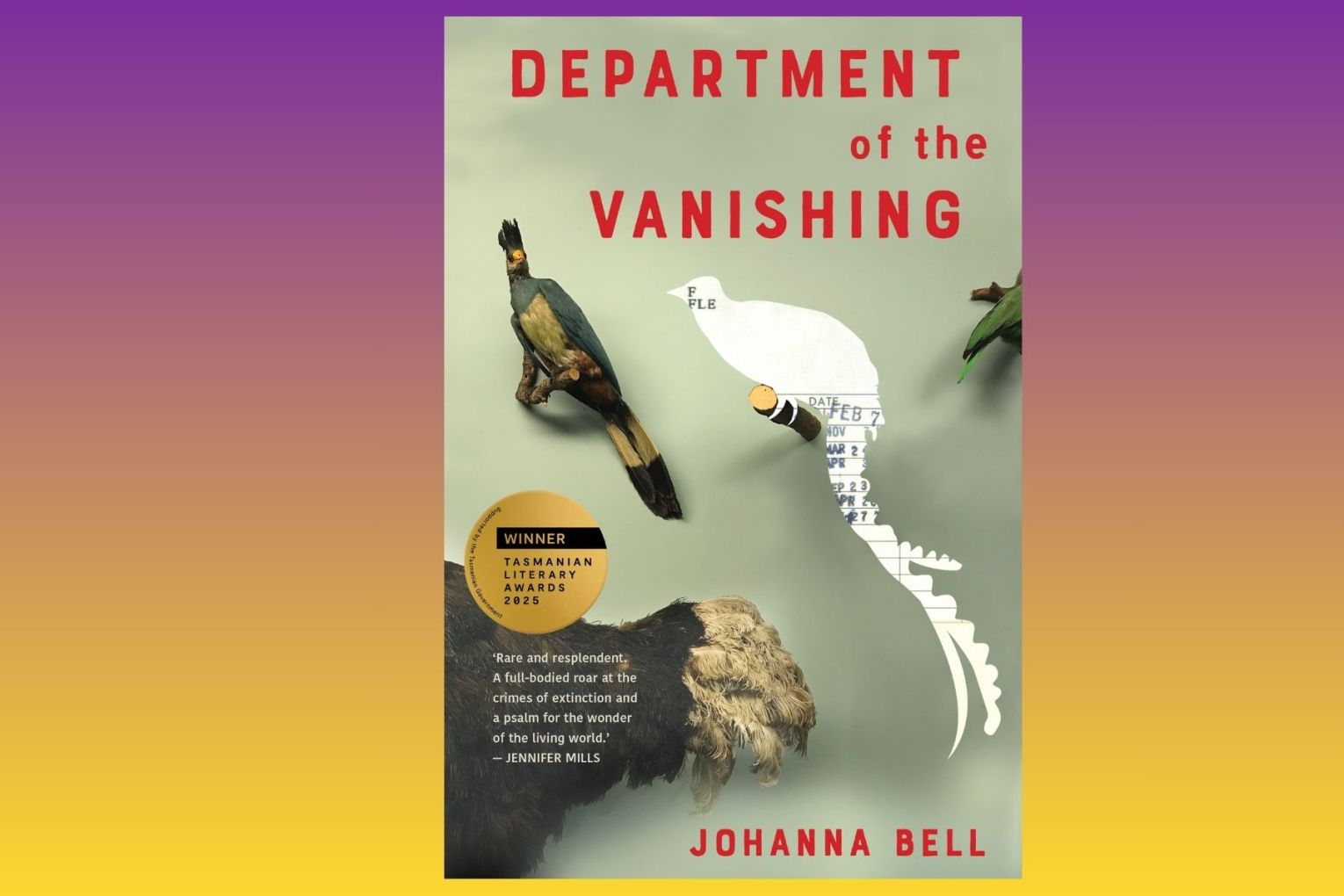
Billed by its publishers as a verse novel “in the spirit of Dorothy Porter’s The Monkey’s Mask”, Tasmanian Literary Award-winner Johanna Bell’s Department of the Vanishing is a first in Australian eco-literature, a brave and boldly experimental mash-up of approaches to, and methodologies of, storytelling that is as groundbreaking and innovative as it is engrossing.
At the heart of Bell’s narrative is 43-year-old Ava, an archivist working in the year 2029 in the Department of the Vanishing at The Department. There, she is wholly absorbed by, and dedicated to, her painstaking work rebuilding lost avian species from the remaining fragments of art and scientific data.
You might like
The broader work done by the department in which Ava carries out her endeavours is represented by overly cheerful and encouraging slogans – “Never Say Die!” and “Vanishing is our name but preservation is our game!”. Before the Anthropocene, the reader learns, “the air pulsed with birdsong”, a sentiment to which the author also refers with her pointed use of a D.H. Lawrence quote to preface the novel: “In the beginning, it was not a word but a chirrup.”
“Anthropocene” is a word coined in 2000. It signifies the “Age of Humans,” characterised by climate change, habitat loss and pollution. Though it was officially rejected as a geological unit of time in 2024, the term is still widely used and comprises “anthropo”, meaning human and “cene”, meaning new. It explicitly identifies and refers to humanity as a major geological force and, to that end, the 2029 in which Department of the Vanishing takes place is a time of major environmental destruction, degradation and loss.
Crucially, it is also a time of mass bird extinction. Thousands of species have disappeared entirely, and others continue to die out, the birdsong that once filled the world increasingly replaced by an eerie silence. Ava’s work as an archivist involves her carefully cataloguing, recording and memorialising the dead species by collating a compendium of information about them, drawn from a variety of sources, once they have been identified as either extinct or perilously endangered.
Department of the Vanishing is a story told in verse, yes, but it is also an immensely clever and complex bricolage using both text and pictures
In order to do this she pulls from everything – from the latest scientific data and research to information derived from much more old-school, analogue technologies such as microfiche and cassette tape recordings.
Readers familiar with watching crime procedural dramas or true-crime documentaries will be familiar with the idea of a murder board. It generally involves investigators using a wall or a whiteboard to piece together clues and information about the case they are working on and it’s a concept that is also useful in describing Bell’s interdisciplinary, piecemeal and cumulative approach to storytelling.
Subscribe for updates
Department of the Vanishing is a story told in verse, yes, but it is also an immensely clever and complex bricolage using both text and pictures – in words and sentences, archival material, black-and-white photographs, redacted transcripts of police interviews and conversations and newspaper headlines – to build and expand its narrative.
This is not, however, a book for readers keen on a straightforward story told in a traditional way. Bell is both author and detective, dropping hints and leaving clues for the astute reader to cobble together in order to construct and understand the vicissitudes of the story she seeks to tell. She has a cracking tale to tell, but she also wants the reader to work for it.
As deeply troubling as the mass extinction of the birds is, the question of why they have become extinct is not what sits at the core of her narrative. The reasons that the birds are disappearing are plain to those willing to look for them and amount to everything from bushfires to pesticides and poisons, wild cat predation, parasites, environmental pollution and the collective impacts of climate change.
One of the most heartbreaking and emotionally resonant elements of the story that Bell tells is the series of obituaries of birds that are scattered throughout the text. It is terrifying to think that in an imaginary year only three years into the future we could be living in a world utterly devoid of magpies, albatross, pelicans, pied oystercatchers, white-cheeked honeyeaters, silver gulls and crimson rosellas, among others.
Department of the Vanishing is certainly a story of environmental loss, but it is also a piercing glimpse into the decades-long heartbreak of its protagonist as she mourns the death of her much-loved father when she was a child and seeks to better understand the circumstances surrounding his demise.
That journey is largely a solitary one for her because her lover, Luke, is flighty and unreliable and her mother is in hospital and dying. Ava’s story, like that of the birds whose disappearances she catalogues, is told by Bell through masterful use and blending of documentary, poetry, narrative verse and archival image.
The grief of which she writes so beautifully, with such melancholy and mesmerism, is not only for a rapidly vanishing wilderness and its inhabitants but also for a middle-aged woman living in a world inescapably largely shaped by the senseless, mystifying loss of her dad. This book demands much of the reader but it also rewards that effort in spades.
Department of the Vanishing by Johanna Bell, Transit Lounge Publishing, $34.99.
Want to see more stories from InDaily Qld in your Google search results?
- Click here to set InDaily Qld as a preferred source.
- Tick the box next to "InDaily Qld". That's it.
Free to share
This article may be shared online or in print under a Creative Commons licence