Book review: Griefdogg
Michael Winkler’s follow-up to his self-published – and later, Miles Franklin-shortlisted – debut Grimmish is a bracingly experimental novel that reflects on country, human connection and the heaviness of being… without being afraid of the odd knock-knock joke.
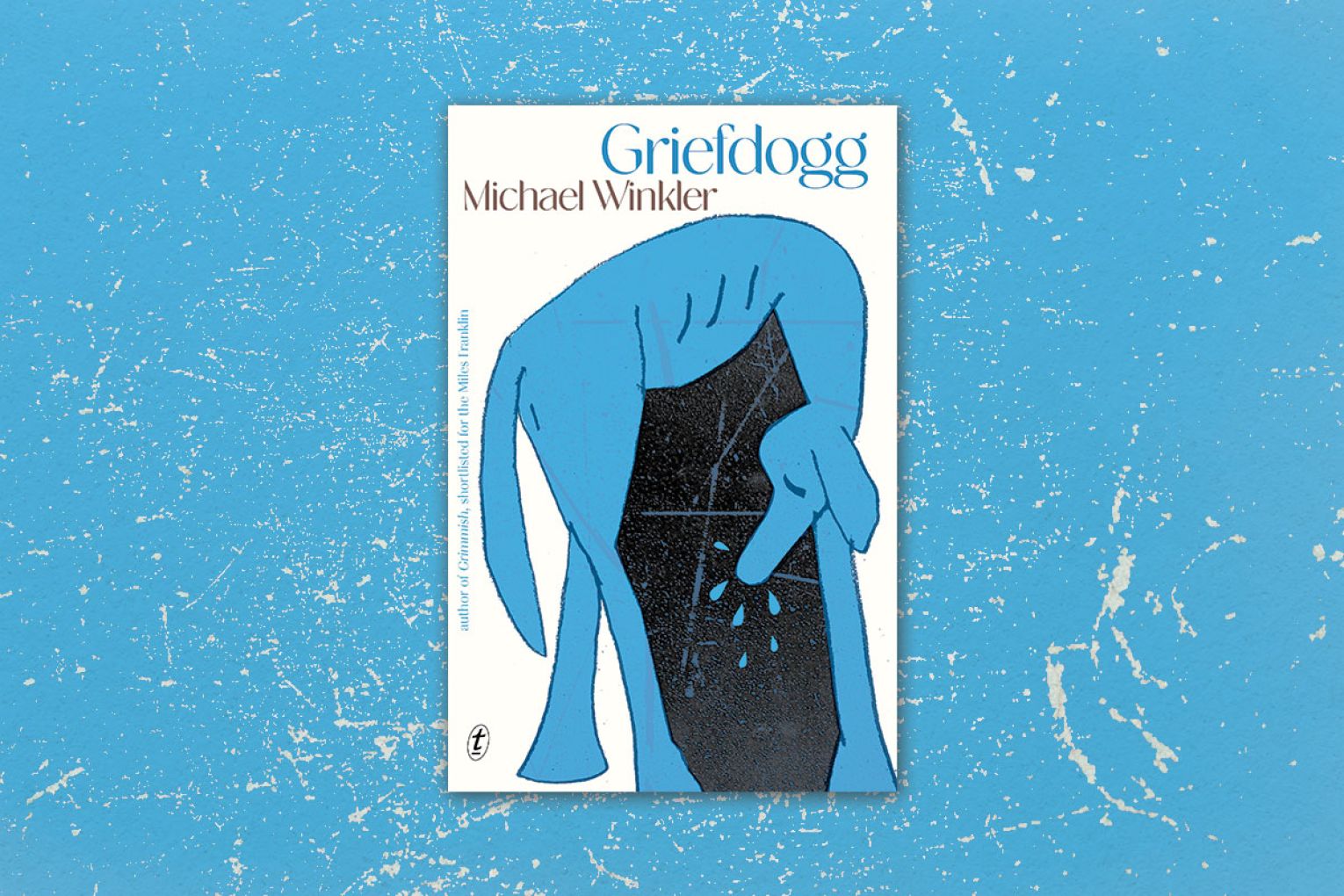
Mildura is a Victorian town about an hour’s drive from the SA boarder, centred on the banks of the Murray River and home to about 40,000 people. Literary fiction isn’t usually set in towns like Mildura – if ever there’s a remote setting, it seems to be a fictional one, based on towns that are familiar yet for some reason not given a chance to properly shine. Michael Winkler’s startling second novel, Griefdogg, pays tribute to the real town, which becomes, in itself, a multifaceted character.
The Powerhouse – and for those who’ve attended Mildura’s welcoming annual Writers’ Festival, this might be familiar – is where the book opens, with someone preparing to eulogise Jeffrey. Or is it Hubert? This is immediately confusing, as is the change between third person and first person, one voice belonging to the book’s protagonist, the other in all probability the creator of that protagonist. But who is eulogising? Who is Hubert?
I admit to being lost for the first thirty pages, but then something twigged and I decided to begin again. And then I couldn’t stop. After three hours had passed, Griefdogg had won me over, rising to the echelon of other books that I had to reread because the first thirty or so pages had me stumped, Alexis Wright’s Carpentaria, for example, and Anthony Burgess’s A Clockwork Orange. What all three of these books have in common, aside from my tenacious rereading, is that they did something with narrative that I hadn’t encountered before. Wright gave us a heteroglossia that suited a culture unrecognised by white readers, while Burgess made up an entirely new lexicon. Winkler’s style is experimental, it’s true, but more to the point of newness and largeness is the way he uncovers a human desperation so damp that cleaning it with description, drying it off with dialogue and fluffing it up with dramatic flair wouldn’t serve his purpose.
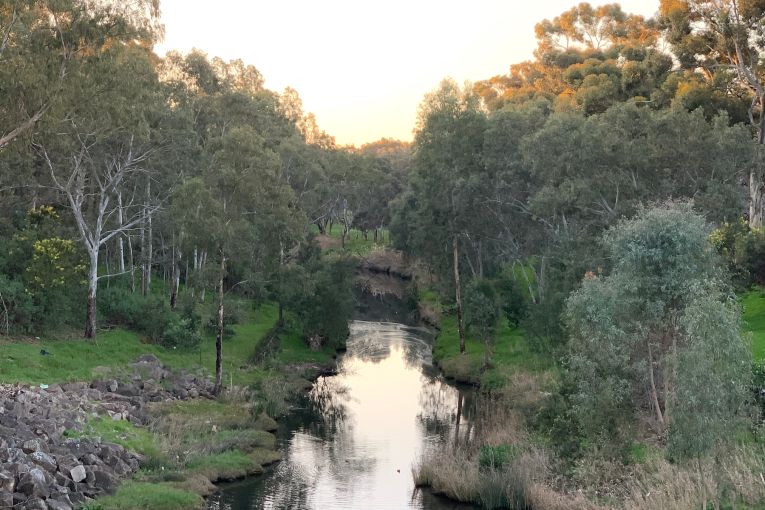
He writes about a feeling most of us are trying to deal with in a world at the brink of extinction, where culture has been so eroded that we have forgotten where it is, exactly, that we come from. He writes about a grief we can’t even understand, and he does this by writing around the grief. That’s Mildura. And what’s at the centre of this swirling, difficult-to-grasp grief? The mighty river Murray.
You might like
Jeffery is a hydrologist, obsessed with the infinitesimal flow of spring water through granite. When he comes into a significant inheritance, he decides to quit his job and his family, too – the monotony of living has become untenable. But he quits the latter in a most unique fashion: he decides to become pet-like, meaning he’ll remain with his family and be looked after in terms of food and shelter, but he’s no longer required to do anything, or even think anything in particular. It doesn’t take long for him, like dogs, to start sniffing out the hurt. Suddenly, every person he comes in contact with has pain that he can sense and that he takes in, lessening it for them. How will he, dog or human, ever escape the unbearable heaviness of being?
What sounds like a would-be downer is a tour de force that’s littered with a humour complimentary to the pathos, and with a premise so bizarre that it demands to be taken seriously. There are a dozen knock-knock jokes alongside references to philosophical rational and Buddhist thinking, and there’s also mentions of First Nations South Australian poets Natalie Harkin (Narungga) and Ali Cobby Eckermann (Yankunytjatjara), because at the heart of this book is a call to a First Nations-led reckoning with nature and time. In a discussion with a new friend at the dog park, the former Jeffery says:
‘There is water down there that’s a million years old. In some places it might be a billion years old. All this water we’ve never seen. We have methods to show that it’s there, and we can do water samples and screen the carbon isotope data to prove that it is unadulterated by anything modern, but almost all of it will be hidden forever. Water in aquifers bigger than human minds can imagine. Water molecules leeching through rock. Well, what if that water had memory? Or feelings? I know this sounds like madness, but just say you embrace the what if: wouldn’t that change everything? Traditional scientific method can only tell us that it’s almost certainly bunkum. But this might sit outside conventional science.’
Some might remember that Winkler was the first writer to be shortlisted for the Miles Franklin Award with a self-published title, Grimmish, which was later reprinted by Transit Lounge. The fact that Grimmish came close to never being read and Winkler to never being celebrated is almost unfathomable when you see where his career is leading him. Griefdogg is an important book about country in its timelessness, and a human connection to country that so many have never even considered. It’s also about the importance of human contact, and the lengths we go to maintain it at very average levels. I am both bigger and sadder, more thoughtful and hopeful for having read the book. It hasn’t given me any answers, but it has taught me that asking useful questions can harness meaning.
Griefdogg (Text Publishing) by Michael Winkler is out now
Want to see more stories from InDaily Qld in your Google search results?
- Click here to set InDaily Qld as a preferred source.
- Tick the box next to "InDaily Qld". That's it.
Free to share
This article may be shared online or in print under a Creative Commons licence