Writing the real: Where history ends and imagination begins
The world of art and reality blur their lines in an exciting new novel of ideas.
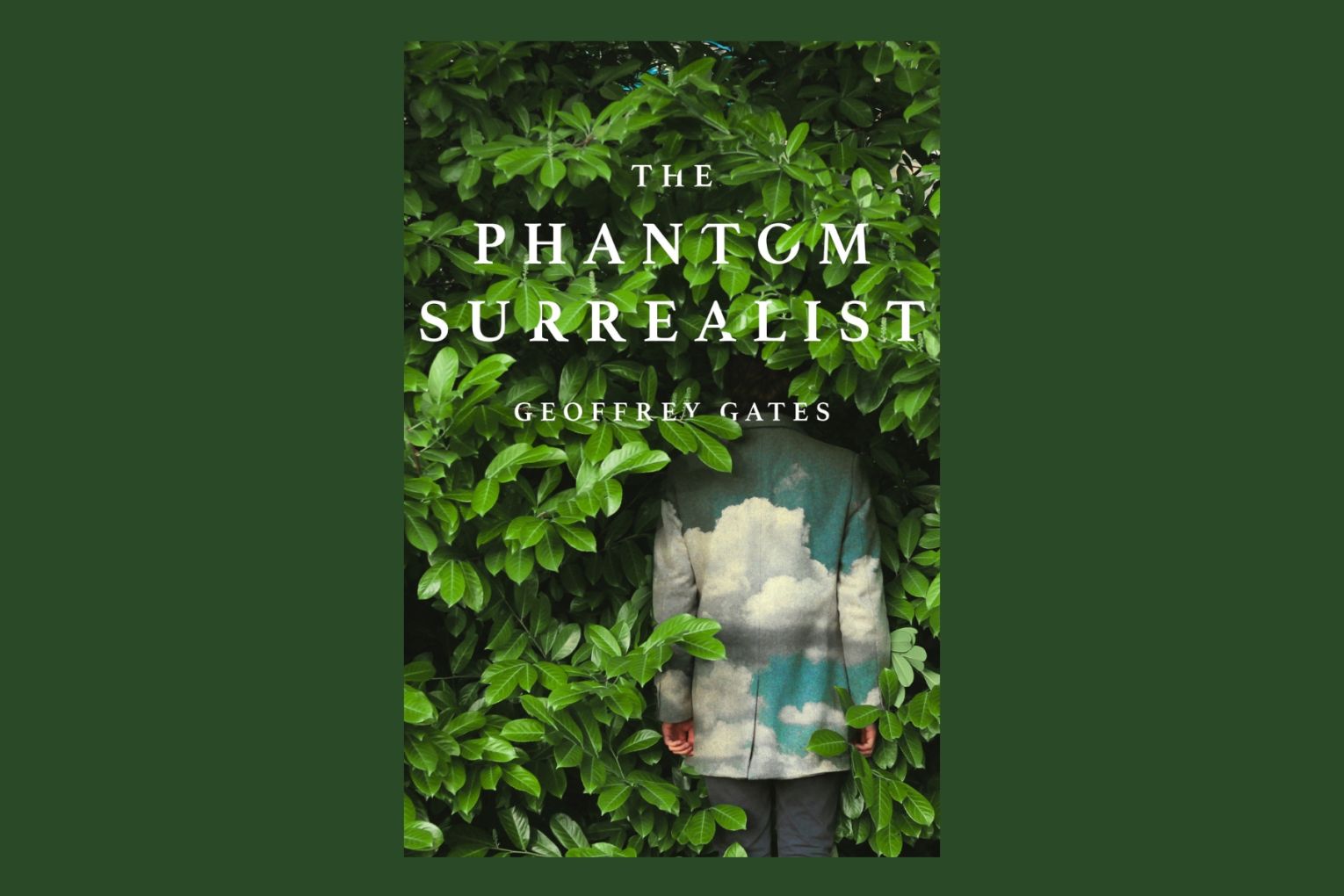
A.S Byatt’s 1990 novel Possession is prefaced with a fragment of poetry by Robert Browning – How did you contrive to grasp / The thread that led you through this labyrinth? / How build such solid fabric out of air? / How on so slight foundation found this tale? / Biography, narrative?
In both that novel and her 2001 work, The Biographer’s Tale, Byatt broadly asks the question whether or not “biography” is the same as “narrative” and “imaginary tale”. In other words: Is biography the same as fiction? And do the two occupy any of the same territory?
Reading Sydney writer Geoffrey Gates latest novel, The Phantom Surrealist, I found myself thinking frequently of Byatt and her fictional interrogations of fact, her explorations of the realms of the real and the imagined, and the intersections and commonalities between the two.
At the heart of Gates’ narrative is Christopher Tiffen, a fine arts PhD candidate who is seeking to tell the story of a little-known Antipodean surrealist painter, Robert J. Wake, and to contextualise his life and work in the wider scope of the history of global and Australian modernism, art and war.

You might like

Tiffen is negotiating a difficult home life, as his long-term relationship with his partner, child psychologist Katrina, crumbles. While wandering a Sydney art gallery, he finds himself inexplicably transfixed by one of Wake’s paintings. He is similarly taken with the young woman who stands alongside him as he views the painting, a Catalan Spaniard named Agnes Buchaca Alert, with whom he will fall in love and whose life will reveal itself to be interwoven with that of Wake in a most profound and unexpected way.
In the course of a single afternoon, Tiffen falls in love, both romantically and intellectually, with his discovery of Wake’s work giving his previously floundering research some much needed purpose and direction, and Agnes stealing his heart.
Somewhat like Byatt’s novels, The Phantom Surrealist focuses on scholarly research, romance and competing intellectual frameworks. All three novels come to rely heavily on the idea of a person’s past – and the past in general – as knowable and quantifiable through sufficiently complete research and documentation, and need readers to believe in the authenticity, reliability and easy interpretation of history and historical records.
Gates’ novel, with its neat blend of fact and fiction, and its exploration of the murky, tenuous terrain of biography – pseudo-biography, if you will – dismantles that premise thoroughly and repeatedly, emphasising the instability inherent in our knowledge of the past. As Tiffen is told by a fellow researcher at one point, “You are trying to reconstruct an artist’s life in your PhD, I think. That’s not so different to a biographer, and a biographer uses all the tricks of fiction.”
Subscribe for updates
Although Wake is a fictional figure, Gates does a thorough and admirable job of writing his imagined creation into real history. Over the course of the novel, the reader learns about Wake’s life from boyhood to his eventual death by way of facts that give his life context and meaning, from the Sydney streets he walked as a teenager to the Australian artists he would have mixed with, including Grace Crowley, Grace Cossington-Smith, Margaret Preston, Russell Drysdale and Donald Friend.
As Tiffen travels the world on an academic research grant, we learn about Wake’s life in France, where he worked on the periphery of the European surrealist movement, mixing with the likes of Pablo Picasso, Salvador Dali, Paul Klee, Rene Magritte, Max Ernst and Paul Eluard; his eventual role as a propaganda artist during the Spanish Civil War, during which he disappears and is assumed dead; and his latter years spent living and working in Greece.
Gates so deftly situates his fictional characters within actual historical times and places that it very quickly feels as if you are reading a true account …
The Phantom Surrealist is littered with what French philosopher Roland Barthes called “biographemes”, units of history or biography, such as historical personages, events and fragments of real documents. They act as a thematic hinge in the novel, allowing for a traditional reading with its emphasis on realism, where the “biographemes” serve as anchors around which the fictional world can cohere and be recognisable as a real world, reinforced by complex characters and literary symbolism.
This is, after all, fiction that is anchored in fact and Gates so deftly situates his fictional characters within actual historical times and places that it very quickly feels as if you are reading a true account of actual biographical research undertaken by a real-life postgraduate student and not, indeed, a work of “faction” (fact and fiction).
In telling the reader the stories of both Tiffen and Wake, Gates cleverly interweaves elements of several genres, quite masterfully combining a love story, a mystery and a pseudo-biography to tell the stories of two men who lived very different lives and whose existences eventually become intertwined, their pasts and their presents enmeshed. Also notable is Gates’ obvious depth of knowledge about the surrealist movement and the Spanish Civil War, both of which permeate his narrative, adding gravity to the story he is telling.
Gates writes about the surrealist emphasis on ephemerality and immediacy, as well as the psychic ramifications of displacement, with insight and ease, and the life story of Wake – the titular “phantom surrealist” – is impressively suffused with details that illustrate how the surrealist movement with which he found himself involved advanced not so much a new set of art practices, but a new mode of moving through the world, a way of living that drew on the unconscious to direct action firmly away from utility and rational discourse.
Wake may never have actually existed, but, in the pages of this excellent novel, Gates writes both the man and his artistic journey into being with considerable dexterity and verve.
The Phantom Surrealist by Geoffrey Gates, Transit Lounge Publishing, $34.99.
Want to see more stories from InDaily Qld in your Google search results?
- Click here to set InDaily Qld as a preferred source.
- Tick the box next to "InDaily Qld". That's it.
Free to share
This article may be shared online or in print under a Creative Commons licence