Riding the golden wave of ‘supercool’ surf flicks
Our obsession with surf movies started in 1966 with The Endless Summer and peaked in the 1970s with classics such as Sea of Joy and Morning of the Earth, according to one non-surfing landlubber.
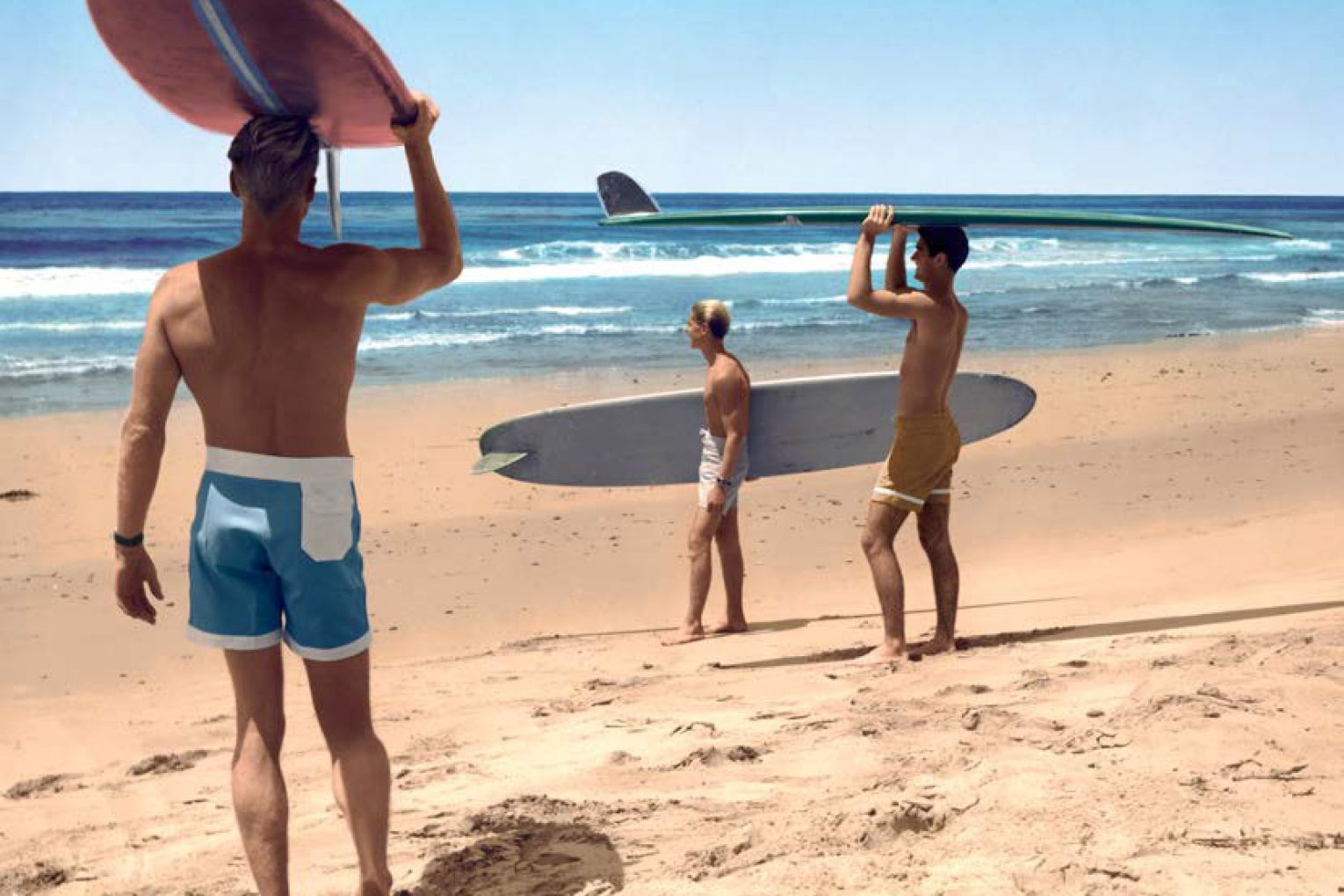
Few film genres are more enduring, iconic, influential, beloved, niche and critically ignored than the surf movie.
Now, when I say “surf movie” I don’t mean dramatic films that include surfing or revolve around the world of surfing – like, say, Point Break, Big Wednesday or Gidget Goes Hawaiian.
I mean non-fiction feature films that basically consist entirely of, well, surfing. Most non-surfers haven’t seen one, neither have film buffs, but for more than 60 years they’ve had a steady, loyal audience willing to sit or lie down to watch 90 minutes of people riding waves, looking cool and … well, that’s about it.
The genre has its origins with 1950s Californian surfing documentaries, which found an enthusiastic reception in Australia among surfers, a growing market at the time. The first feature-length picture about Australian surfing, Surf Down Under came out in 1958 and was followed by a slew of titles from local filmmakers such as Bob Evans and Paul Witzig.
Movies like High on a Cool Wave, Ride a White Horse, The Hot Generation, Evolution and Sea of Joy would typically be played in ad hoc venues such as rented church halls, where they found a steady popularity, particularly along the east coast of Australia.
The golden age of surf movies, as it was, began with The Endless Summer (1966) directed by Californian college-drop-out-turned-photographer Bruce Brown. The film had the perfect title, concept, poster, soundtrack and release date. It became a box-office phenomenon, becoming a surf movie unicorn – one that crossed over to non-surfing audiences.
You might like

‘The day after watching one you just want to surf your head off’
This popularity led to a surge in surf movies, including two Australian efforts that have come to be regarded as classics of the genre – Morning of the Earth (1972) and Crystal Voyager (1973). What was the appeal?
“Surf movies were and are a validation of a surfer’s life,” says journalist and former surfer Phil Brown. “They are also a way to get stoked all over again. The day after watching one you just want to surf your head off. They also chronicled our subculture.”
According to Brown, Australia’s Morning of the Earth is the surf movie that best captured what it was like to ride the waves.
“It is a spiritual touchstone for surfers and captures the poetry and the beauty of the natural experience of surfing,” he says. “It shows the joy and freedom and for some of us it brings a tear to the eye. Plus, it has a killer soundtrack!”
Subscribe for updates
Aside from Endless Summer, none of these movies had much appeal to non-surfers, thus were rarely reviewed or screened in traditional cinemas. They rarely made it very far inland.
However, Australia has a lot of coastal towns and the films weren’t expensive to produce and filmmakers could earn decent coin exhibiting them themselves. David Elfick, who produced Morning of the Earth (with Albert Falzon) and Crystal Voyager, called the income “wet money”, as the bank notes his audience used to pay for tickets were often damp from the ocean.
Surf movies were not the only specialist, non-traditional, non-narrative, self-distributed documentaries being made at the time. The best known were travel movies, whose makers included such people as the Leyland Brothers (before they moved into television) and Alby Mangels.
There were also ski films, which employed many of the same stylistic techniques as surf movies although, unsurprisingly, they never enjoyed the same popularity in Australia. Incidentally, all these genres received scant critical or even business respect from the filmmaking establishment in Australia. Surf movies seem to be particularly disdained or ignored, despite their popularity – in part, one suspects, because a lot of film critics simply dislike surfers.
The golden age of surf movies lasted until the mid-1970s – roughly around the same time as the Vietnam War. This was not entirely coincidental – during its early days surfing was not seen so much as a sport as a lifestyle that was very much part of the counterculture. Indeed, surfies of the 1960s and early 1970s were in frequent, sometimes violent, conflict with more establishment figures such as surf life-saving clubs, the police and, well, anyone with a nine-to-five job.
In the mid-to-late ’70s this all changed as surfing went mainstream and the counterculture was absorbed by “the culture”. Competitions became more organised, the money involved in surfing turned serious and previous “hidden” spots like Bali and Noosa morphed into hugely popular tourist destinations. The sport bled into more traditional narrative Australian films such as Summer City (1977) and Puberty Blues (1981).
Surf movies remained popular – they are still produced today – but the market became saturated and the filmmaking increasingly orientated towards brand promotion, volume and/or VHS consumption, with an ensuing impact on quality and content. Surfing even started producing its own billionaire tycoons like Nick Brookman and Bob McKnight. It’s hard for something to remain anti-establishment in such an environment.
Nonetheless, good work continues to be produced and the best surf movies retain their power to inspire, stimulate and transport.
If you have a spare moment, pop down to Brisbane’s GOMA which is showing The Endless Summer and Morning on the Earth on the big screen. It’s not quite the same as watching it in a dingy coastal town hall while smoking herbal cigarettes among long-haired surfies who were dodging the draft (circa 1972), but it’s the next best thing.
The Endless Summer and Morning of the Earth are screening at GOMA as part of its Perceptions of Light series, which continues until April 26.
qagoma.qld.gov.au/cinema/screening/morning-of-the-earth-2026-01-21
qagoma.qld.gov.au/cinema/screening/the-endless-summer-2026-01-21
Want to see more stories from InDaily Qld in your Google search results?
- Click here to set InDaily Qld as a preferred source.
- Tick the box next to "InDaily Qld". That's it.
Free to share
This article may be shared online or in print under a Creative Commons licence