Finding the extraordinary in the rather ordinary
Robert Malherbe works with urgency to create compelling paintings and his latest exhibition at Jan Murphy Gallery is a response to seeing the light.
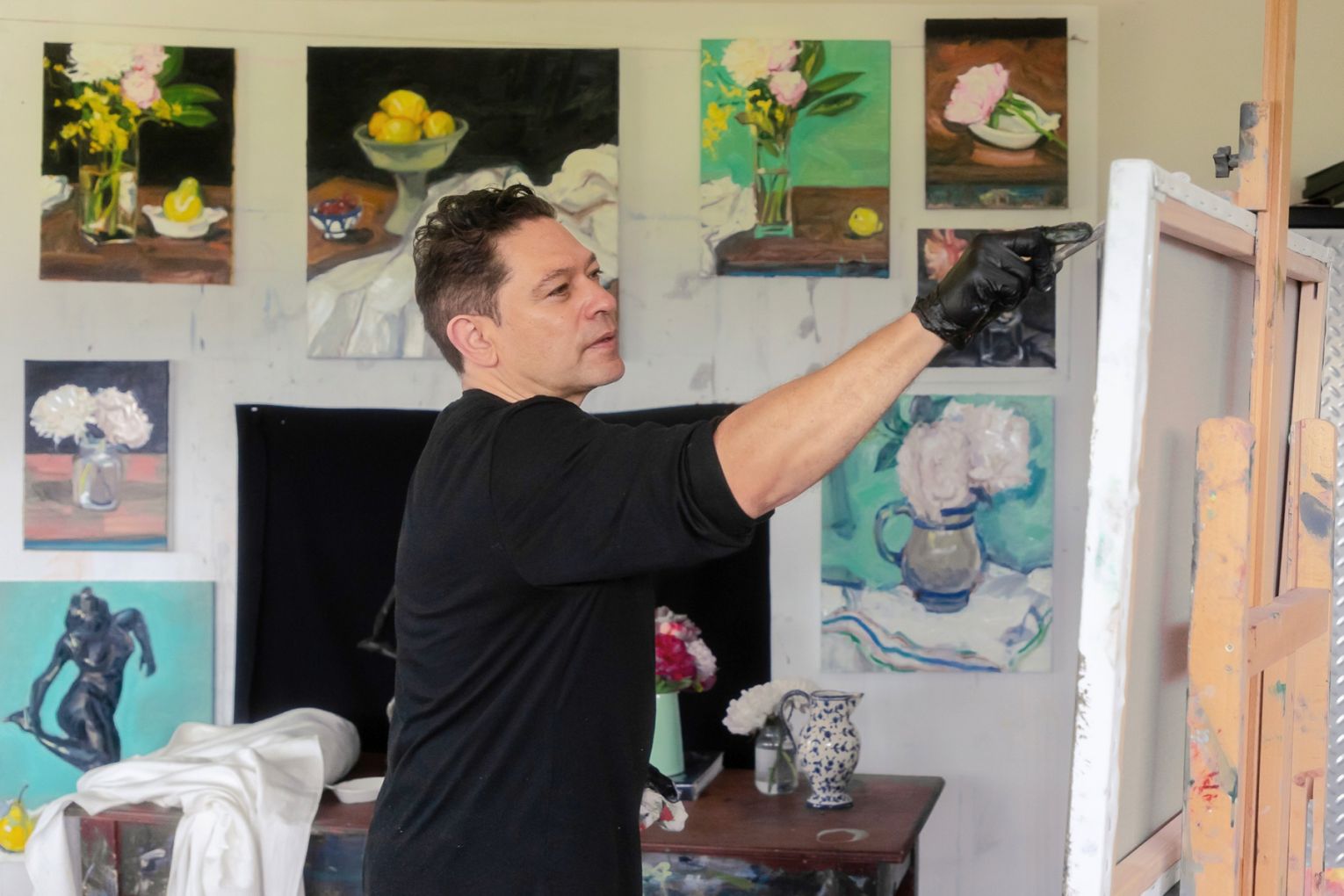
In Robert Malherbe’s paintings, we encounter the landscape, figures and still life that capture a particular moment, greeting the external world with a luscious intensity that takes us inside the psyche.
His en plein air practice generates a freshness that the artist brings in response to the beauty he identifies – in a group of pines echoed in a lake or a rose lying central on a black table. This physical immediacy has been part of Malherbe’s art practice, integral to his method of creating a painting in one sitting, alla prima, since he began exhibiting in the early 2000s.
And these works conjure William Blake’s words in their evocation of the preciousness of ostensibly ordinary objects – their ability to contain the universal in the everyday (Heaven in a Wild Flower).
In his latest exhibition, Almost the Sun, at Jan Murphy Gallery, there is a shift of sorts in Malherbe’s painting practice. The underlying ground in each of these thickly impastoed paintings is silver, a felt response to the light in the Blue Mountains.
Despite being resident for some decades, the recent relocation of his studio to the back of his house now means that instead of travelling to his Darlinghurst, Sydney, studio most days, he simply goes out the back. In this transition, he found the local light surprising, with the exhibition title describing the glare of sunlight through cloud.
“The light is quite blinding,” Malherbe says. “It has real volume. I was sitting in this wonderful new space, looking outside. And every day was just cloudy. But then I noticed the beautiful silver sheen to the sky and thought, why don’t I just put silver down first and then paint the picture on top of that?”
You might like
Given his observations of the European masters, he was well aware of the art historical tradition of painting on a prepared coloured ground to impact light, luminosity, tone and emotional register.

Malherbe has been obsessed by drawing since he was a boy. He found having to go to school an inconvenient diversion. He recalls being introduced to painting at about age eight through books his mother brought home, including one on the collection of Washington’s National Gallery of Art.
After leaving school at 16 he ended up with his drawings under one arm at an animation studio. He met Nicholas Harding, who became a lifelong friend (given their shared painting ambitions), at the legendary Yoram Gross studio in Sydney. Malherbe went on to work for Hanna-Barbera and Disney and spent a decade travelling to London off and on, working on feature films.

“On Sundays I’d go to the National Gallery or the Tate,” he says. “I taught myself how to paint that way. I think generally every artist is self-taught.”
Subscribe for updates
He left his animation career and salary when his first child was due, an unusual response to fatherhood but, for him, modelling the importance of following your dreams. He was 34 when he had his first exhibition, and while he brought the facility he had with drawing and animation to the work, his paintings approach the subject from the opposite direction.
“Illustration is all about trying to convince the world, and painting is about trying to convince yourself,” he says. “Painting is about sensation rather than information, and I want those sensations to surprise me and the viewer.”
The silver background to each of these new paintings gives each an underlying sheen, a muted emotional register that holds tension. Silver coastal tree (2026) casts a bright yet muted light over a tree developed with gestural thick paint, the energy of its verdant growth expressed in scribbly lines that create a tangle, ribbons of colour that segue into a beach in the foreground, a small area of water and a landscape with indistinct features on the horizon line. Etched into the paint are scratched-back areas, with a sense that this mass of vegetation is permeable, open, while the energy pushes upwards, as voracious as a fire.
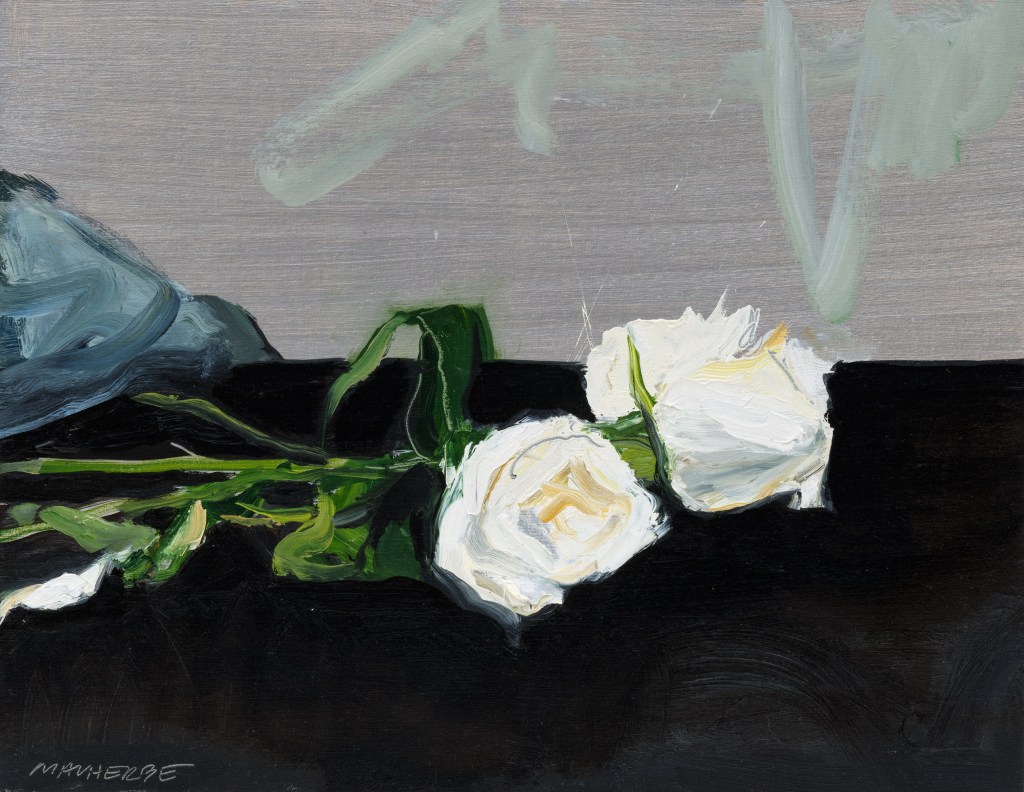
Roses on black (2026) is quieter, the flowers horizontal, as though in repose. White petals are stark against the black, the deep green of the leaves intruding into the silver that divides the painting horizontally, as does a bluish shape on the left. A scribble in soft green over the silver balances the composition, the stillness of the roses balanced by its expressive line.
Figures that Malherbe paints from a live model in the studio, also in one sitting, convey a sense that the ambience outside permeates the mood. Sitting figure (2026) creates the body, knee elevated, head down, in thick paint, white and grey relieved by orange and red markings for fingers. It’s an evocative exploration of a body, carved with paint and contained by silver, black and grey. It communicates a sombre sensibility.
For Malherbe, a painting is “a small world, a little universe that you’ve made that goes beyond verbal language. I paint the figure like a landscape, and I paint the landscape like the figure”.
His ambition is to fuse the subject and the painting within their materials. “Although you are painting flowers, it doesn’t have to be about flowers,” he says.
His interests in the language of paint pay homage to the artists drawn from the European tradition that he has observed at museums – like Walter Sickert, Henri Matisse, Pablo Picasso and Paul Cezanne.
His work exudes a contemporary freshness, the temporality of his approach expressed using the paint itself. In terms of how long it takes to create each painting, he suggests, “About two hours and a lifetime.”
Almost the Sun opens the gaze from the ordinary to the universal.
Robert Malherbe – Almost the Sun, Jan Murphy Gallery, Fortitude Valley, September 30 until October 24.
Want to see more stories from InDaily Qld in your Google search results?
- Click here to set InDaily Qld as a preferred source.
- Tick the box next to "InDaily Qld". That's it.
Free to share
This article may be shared online or in print under a Creative Commons licence