World is watching as prisoner Pell faces his ultimate judgement
George Pell’s fate is in the hands of the ultimate legal umpire today — not God or the Vatican, but the High Court of Australia in Canberra.
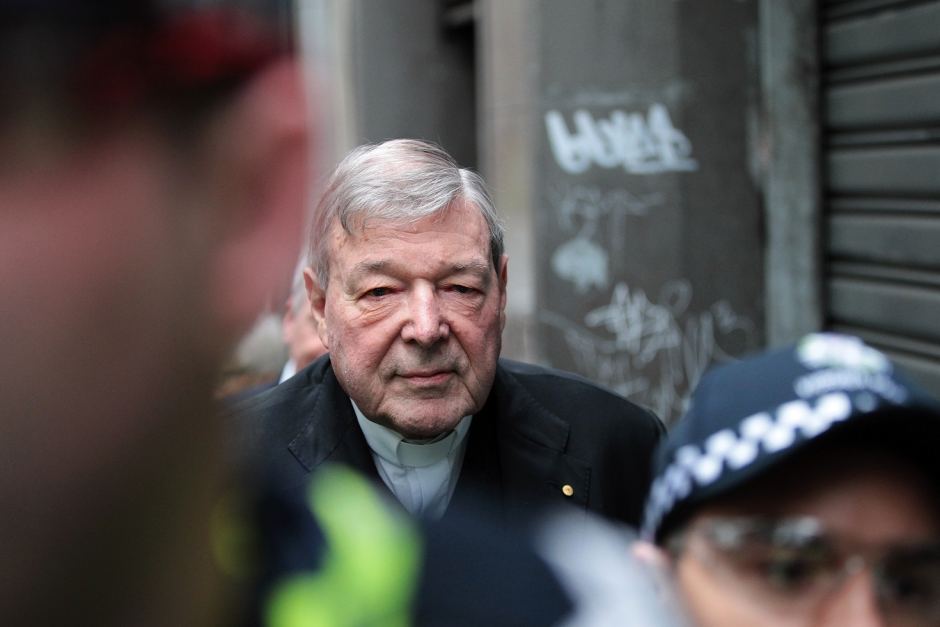
The 78-year-old is serving a maximum six years in jail after a jury found him guilty of sexual offences against two choirboys in the late 1990s when he was Archbishop of Melbourne.
Today, all eyes — in Australia and overseas — will be on the court, as it ponders the future of the former advisor to the Pope and most senior Catholic to be convicted of child sex offences.
Pell’s lawyers are hoping to convince the High Court the jury made a mistake, and his conviction should be quashed.
But lawyers in the case have already locked horns, in unusually combative written submissions.
Pell’s lawyers have accused prosecutors of reversing the onus of proof and taking a “passive” approach to witnesses whose evidence might not have supported their case.
Meanwhile, lawyers for the prosecution have told the High Court that Pell’s case is “weak” and glosses over evidence that supports the victim known as “A”.
The case is extraordinary because of who is involved and what is at stake. But, on another level, it is a standard historical sexual abuse case based on the word of a victim against that of a person of authority, years after the events.
How did the case get to the High Court?

Pell’s case revolves around sexual offences against two choirboys who snuck away from the post-mass procession and were caught by Pell swigging altar wine in the priest’s sacristy.
This was then followed by a second offence in a momentary encounter with Pell’s accuser weeks later.
You might like

A complication in the Pell case was that the second boy had died before the matter was reported to police 2015 and, when asked in 2001 by his mother, he had denied ever suffering abuse.
Nonetheless, a jury convicted Pell of five charges in 2018.
Pell’s lawyer Robert Richter said he was so “angry and upset” by the result he could not go on, leaving the subsequent appeals to barristers Ruth Shann and Bret Walker.
The first, in the Victorian Court of Appeal, found in a two-to-one decision that A was a witness of truth and it was open to the jury to find Pell guilty beyond reasonable doubt.
It is this decision and the manner in which it was made that will be the focus of the High Court challenge today.
It is also familiar territory for the court.
High Court to examine the use of the ‘M Test’

At the heart of the submissions put to the court so far is something called the “M Test”, from the 1994 High Court case M v the Queen.
It requires appeal courts to make an independent assessment of the evidence, and then to decide whether it was open to the jury to arrive at its verdict beyond reasonable doubt. It is meant to protect jury decisions, except in situations where there has been a mistake.
Just how the Victorian Court of Appeal carried out that task is what is at issue in the High Court.
The case, put forward by Pell’s lawyers in the trial, the appeal and the now the High Court, relies heavily on so-called “solid obstacles” to conviction.
Witnesses involved in church activities at the time gave evidence that raised a series of questions about whether the crime was possible, and whether Pell would have had an opportunity to commit the offences.
The evidence ranged from the centuries-old tradition of never leaving an Archbishop alone while robed; to whether Pell could have even committed the offences while robed; and whether the scene of the crime, the Priest’s Sacristy, would have been vacant for the five or six minutes the offending was said to have taken place.

A great deal was also made of how Pell would spend time on the church steps after mass, talking to worshipers.
Stay informed, daily
His lawyers said that all of this evidence about the practices and routines at St Patrick’s Cathedral in Melbourne effectively provided Pell with an alibi, and showed a lack of opportunity.
But two of the judges on appeal, Chief Justices Anne Ferguson and president Chris Maxwell, disagreed, saying they were not convinced.
“No witness could say with certainty that these routines and practices were never departed from,” they said in their decision.
Pell’s lawyers now argue that the Court of Appeal did not apply the M Test correctly, by treating each issue in isolation.
“The point is that the majority did not independently weigh the combined effect of the evidence,” Pell’s lawyers said in their submission.
They preferred the dissenting opinion of Justice Mark Weinberg, who found there were compounding improbabilities established by the evidence.
Onus of proof reversed, Pell’s lawyers argue
A major thrust in the case put forward by Pell’s lawyers is that the appeal ruling reversed the onus of proof and required Pell to establish actual innocence.
They have also accused the appeal judges of basing their decision on belief in A alone.
Not surprisingly, in its written submissions to the High Court the prosecution has refuted that.
“The majority did not reason on the basis of ‘belief’ in A,” they said.
“Rather they ‘reviewed the whole of the evidence’ and made an assessment of A’s credibility and reliability.”
The prosecution said the account by A was supported by evidence, including his account of the offence happening in the priest’s sacristy.
The sacristy was being renovated at the time — a detail not many other witnesses could recall.
One of the curious things in the case was that the Victorian Court of Appeal did not stick to the transcripts, as would normally happen.
The three judges watched videos of the victim and several other witnesses giving their evidence, in the same way the jury would have. They also visited the cathedral.
The court asked for extra submissions on whether the M Test allows such a thing, or restricts appeal courts to the transcripts.
Today, the High Court will hear the arguments from both sides.
But a decision is likely to be months away.
– ABC / Elizabeth Byrne
Want to see more stories from InDaily Qld in your Google search results?
- Click here to set InDaily Qld as a preferred source.
- Tick the box next to "InDaily Qld". That's it.