Australia’s population growth truth, amid anti-immigration rhetoric
Just released population numbers reveal an important truth amid latest calls to curb immigation. Matt Grudnoff urges Aussies to stop and take a breath as the devastation over Bondi has rhetoric heating up.

Population and immigration were hot issues even before the terrible attacks at Bondi.
Before the rhetoric heats up even more, let’s stop, take a deep breath and have a look at what the facts say.
Fortunately, the Australian Bureau of Statistics has just released the latest population numbers. So, let’s dig and have a look at exactly what is happening to the Australian population.
The most important thing to keep in mind is that, along with so much else, the Covid-19 pandemic upended population growth.
When the borders shut in 2020, population growth dropped to its lowest level since federation.
Those who weren’t citizens or permanent residents could no longer enter the country, and many of those who were already in Australia, were forced to leave when the shutdowns ended any possibility of earning a living.
It wasn’t all one-way traffic, as many Australians living overseas faced the same issues in other countries and returned home.
You might like

As a result, the population barely increased for a year and a half. Over the 18 months from April 2020 to September 2021, the population increased by just 77,000. To put that in context, in the 18 months before Covid Australia’s population increased by 561,000.
But after the borders reopened, both in Australia and around the world, we saw population growth bounce back.
Many Australians left to again take up their lives overseas, while many people from overseas came back to Australia.
Australia foreign students are a good example of this. Forced to leave during the pandemic and study at a distance, they came back to Australia when in person classes resumed.
The figure below shows quarterly changes in population over the past 10 years.
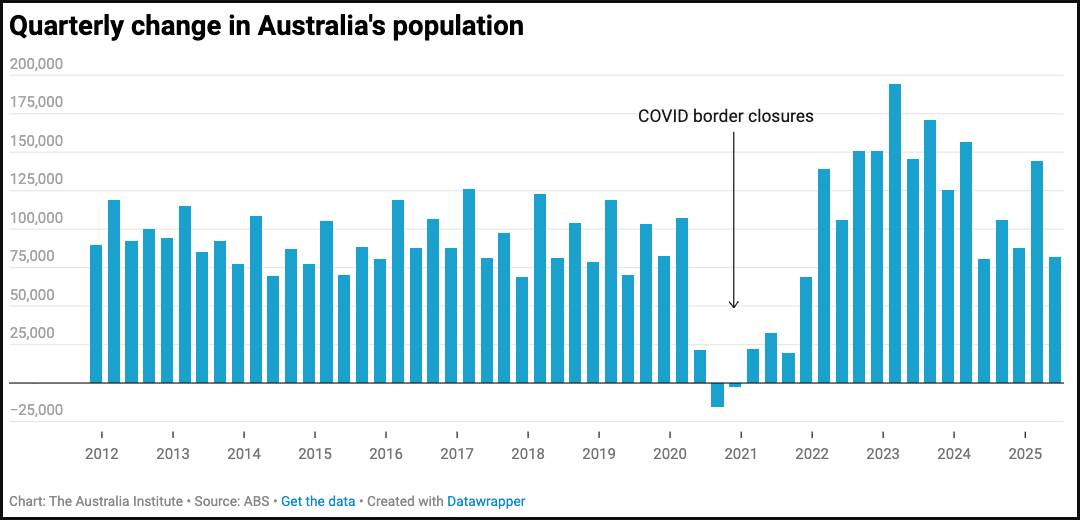
We can see the collapse in population growth during the pandemic, followed by an increase in growth above the pre-pandemic average when the borders reopened.
In the latest quarter for which data is available – June 2025 – there has been a relatively small increase in Australia’s population, but nothing unusual, at least not for the past 10 years.
Stay informed, daily
While the quarterly numbers are quite noisy (they move around a fair bit), the past five quarters appear to have settled down to be like the pre-pandemic average.
Before the pandemic, the average population growth was 1.5 per cent per year. Over the past year, the population has increased by 1.4 per cent.
So things are basically back to normal after Covid, but what was the overall effect of this disruption? Did the drop in population growth when the borders were shut offset the rapid growth in population when they opened again? Or has the population really grown much more rapidly than it otherwise would have?
We can work this out by looking at what the population would have been if it had simply grown at the pre-pandemic average rate.
This is shown in the figure below. The blue line is the actual growth in the population with Covid, and the dotted orange line is what the population would have been if it had continued to grow at the average rate without the pandemic.
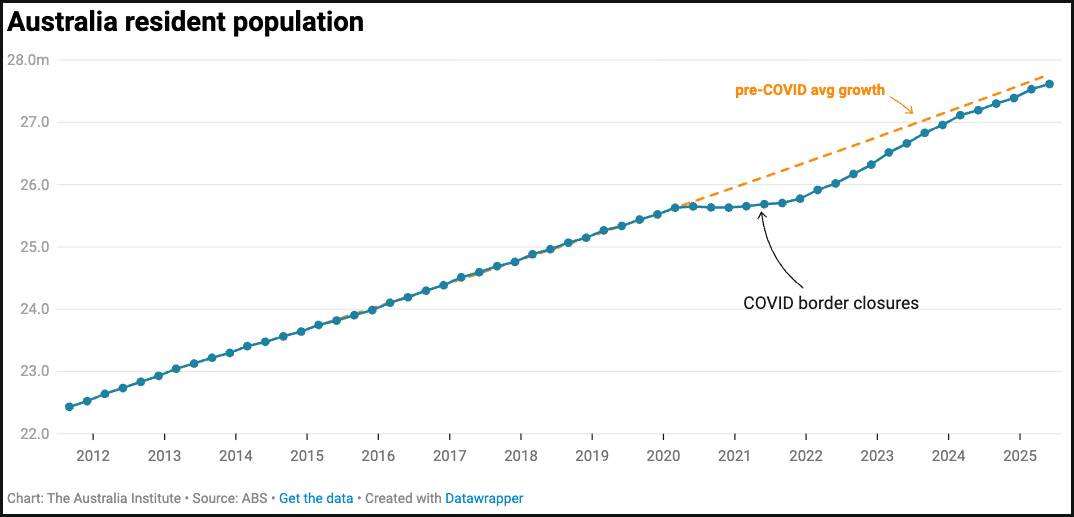
We can see there is almost no difference between the two. In fact, Australia’s population is actually is ever so slightly lower than it would have been without the pandemic. But the difference is so small that it is not particularly meaningful.
Some might be keen to talk about out-of-control immigration, but the reality is that growth has been steady over the long term.
While the past five years may have brought dramatic fluctuations in population number, in the end it has grown at about the same rate as it did before the pandemic.
Matt Grudnoff is senior economist at the Australia Institute
This article first appeared in The Post. Read the original here
Want to see more stories from InDaily Qld in your Google search results?
- Click here to set InDaily Qld as a preferred source.
- Tick the box next to "InDaily Qld". That's it.