The Stats Guy: Did my predictions for 2025 come true?
The Stats Guy earns a living using demographic data to forecast the future. Here’s how his predictions for 2025 turned out.

I earn a living using demographic data to forecast the future.
At the end of last year, I published not one but two columns outlining my 20 predictions for 2025.
Now that the year comes to a close, it is time to review my forecasts. How did I do?
⛔ My first forecast was a tongue in cheek prediction that Peter Dutton would become prime minister simply because he was 54 at the time. That age just happened to be the average age of new PMs at the time. Not a good start …
✅ Second, I forecasted that more Australians than ever before would vote for third parties in the federal election. That came true as more than a third (33.6 per cent) of primary votes in May ended up with the third parties. Collectively, Labor and the Coalition have never been weaker.
❓(likely a ✅) Third, I argued that 2025 would bring a high net overseas migration intake but the final tally will be below the 2024 figures.
The correct dataset gets published by the ABS only on December 19, which happens to be when I clock off for the year. It’s important to remember that migration data is different to the overseas arrivals data – often arrivals data is used to make migration data sound more shocking.
The preliminary data that we have suggests that our 2025 migration intake will be well below the 2024 figure.

Source: Matusik Missive, December 2025
✅ Birthrates continued to fall, as I predicted. Statistically, births are reported with a significant lag. This means we are comparing 2023 and 2024 data. The total fertility rate (TFR) sat at 1.499 in 2023. By 2024, this number fell to 1.481. TFR measures the average number of registered births per woman aged 15 to 49.
Counterintuitively, the midwives of Australia still had a very busy year as the total number of births went up (287,000 to 292,000).
The increase was due to the gigantic millennial generation being responsible for most of the baby-making for the next decade. As long as the millennials grow their families even at modest rates, the maternity wards of Australia will remain busy, despite falling TFR.
✅ I predicted that the unemployment rate would comfortably remain below 5 per cent. As of October 2025, the unemployment rate sat at a low 4.3 per cent.
✅ I argued that greenfield sites will get more population growth than infill areas in 2025. That’s simple market logic in action.
You might like
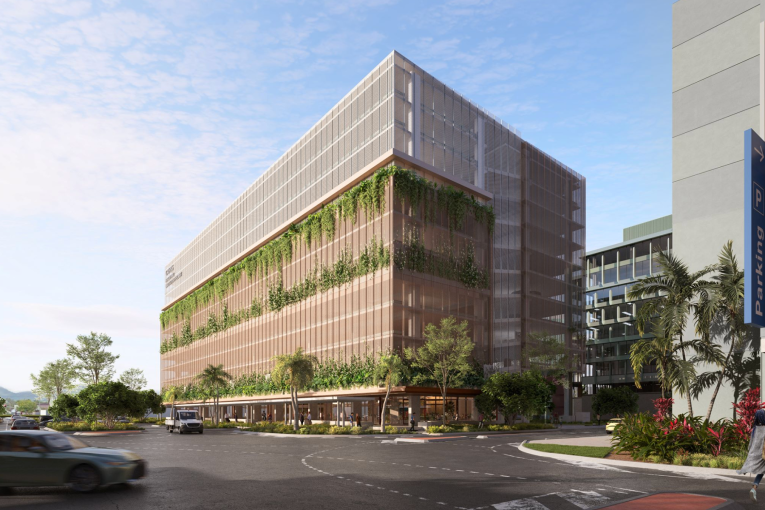
Developing a square metre of housing on the urban fringe costs about half as much as a square metre of medium- or high-density housing. The relative costs of development remained in 2025.
This was, of course, bad news for urban planners who want to densify Australian cities to optimise infrastructure use.
❓(maybe even a ✅) I argued that Melbourne will soon be the most affordable capital city in Australia, but questioned whether this would happen in 2025.
Melbourne had the slowest annual increase in dwelling values this year. It also offers cheaper dwellings than Sydney, Brisbane, Perth, Canberra and even Adelaide. The relative affordability of Melbourne will continue to attract young people.
I am not giving my self a ✅ here since my forecast was sloppy – clearly Melbourne won’t be cheaper than Hobart or Darwin any time soon.
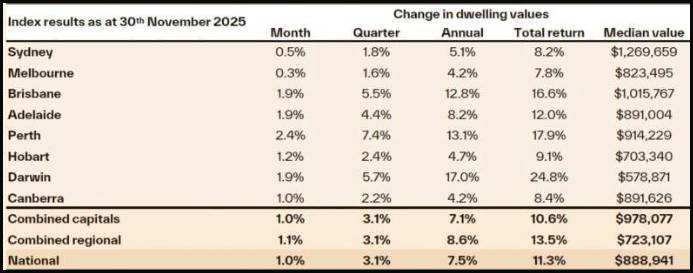
Source: Cotality, 1 December 2025
✅ As predicted, Australia became more multicultural. When I made the predictions last year, 30.7 per cent of Australia’s population was born abroad. That figure went up to 31.5 per cent.
Forecasting the direction of this trend is, of course, super easy since more than two-thirds of population growth stems from overseas migration.
✅ The ninth prediction also was an obvious one. I claimed that Australia would continue to grow old.
As migration intake slowed (super-high migration can lead to a lowering of the median age), it was clear that the median age of Australians would continue to climb.
In June 2023, median age sat at 37.8 years – a year later it had climbed to 38.5 years. For context, this makes us as old as the US but significantly younger than Germany (45.5 years) or Japan (49.8 years).
❓(but let’s be honest, it’s really a ✅) I claimed that first-home buyers will continue to get older and that age-dependent homeownership rates will continue to fall.
Such data is very hard to come by. I don’t have up-to-date data allowing a comparison from the same source for 2024 and 2025.
From my conversations with property and banking experts, I am certain that the average first-home buyer has got older. Without data no checkmark though.
⛔ I predicted, simply based on demographics, that 2025 would bring more car sales than 2024. The logic for that is the big millennial generation moving into the family formation stage of the life cycle and needing multiple cars per households.
Based on data from the Federal Chamber of Automotive Industries, we learn that 1,111,064 new vehicles were sold in Australia between January and November 2025. This compares to 1,124,712 units sold in the same period in 2024, a decline of 1.2 per cent year-on-year.
New car sales dipped in 2025 largely because cost-of-living pressures finally caught up with would-be buyers. Households facing higher rents or mortgage repayments, as insurance premiums and grocery bills also rise, are putting off big purchases.
The sharpest slowdown was in the private buyer segment. A new car is an expensive purchase that you can comfortably postpone.
✅ Further, I predicted that electric vehicles would make up a larger (albeit still modest) share of new car sales. This turned out to be true.
The six-month rolling average for October 2025 showed that 8.8 per cent of new cars were fully electric – a year earlier that number sat at 7.0 per cent. Considering that many corporate fleets have to switch to EVs, the share should continue to go up.
✅ As predicted, inbound tourism numbers in 2025 were stronger than in 2024. Inbound tourism rose strongly in the year to September 2025, increasing from 8.1 million to 8.6 million visitors, a lift of roughly half a million people.
The growth was driven by sharp rebounds from key markets such as China and Britain, plus consistently strong monthly arrivals through most of the year. Improved airline capacity and Australia’s renewed appeal in major Asian and Western markets helped accelerate the recovery.
Stay informed, daily
⛔(a generous interpretation would split the forecast into ⛔ & ✅) I forecasted (like most economists) that inflation would ease a little bit in 2025 and that we would see an interest rate cut or two.
Further, I argued that the return to a low-interest rate environment remains unlikely. Inflation increased but rate cuts came nonetheless (the cash rate dropped from 4.35 per cent to 3.60 per cent). I am giving myself a miss here because I want to be fully correct to earn that ✅.
✅ I correctly predicted that retail spending was going to be noticeably stronger in 2025 than in 2024. ABS data shows that monthly turnover consistently ran about 4-5 per cent higher than the year before, with September sales alone rising from 36.2 billion dollars in 2024 to 37.8 billion dollars in 2025.
Despite cost-of-living pressures, Australians continued to spend more across most categories, signalling a resilient consumer sector even as household budgets remained tight.
The high retail spending was aided by the biggest generation ever (the millennials) entering the highest spending phase of the lifecycle (their mid-40s). Millennials will continue to spend like there is no tomorrow for the coming decade. Our national retail sector will benefit handsomely.
✅ I predicted that 2025 would bring more geopolitical instability, with declining great-power influence creating regional power vacuums, rising support for political extremes in Europe, and fresh conflicts across Africa and the Middle East.
I also argued that while global uncertainty would make international business more difficult, Australia’s simple economic model built on mining, agriculture, tourism and international education would continue to hold up.
Looking back, this forecast proved broadly correct. The world did experience another year of geopolitical tensions and regional conflicts, Europe ramped up defence spending amid political fragmentation, and global trade routes were repeatedly disrupted.
Yet Australia’s key export sectors remained in strong demand and continued to deliver solid growth, proving once again that in turbulent times the national instinct that “she’ll be right” often ends up on the money.
✅ I also forecast that 2025 would be a strong year for indoor play centres, driven by shrinking backyards, more parents working from home and growing reluctance to let children roam independently in car-dependent suburbs.
While harder to measure directly, the evidence points in the right direction. Industry reports show Australia’s family and indoor entertainment sector expanding, venues opening on urban fringes, and shopping centres increasingly incorporating dedicated play spaces to attract young families.
The demand drivers I identified are clearly playing out, and early signs suggest that indoor play centres are indeed enjoying the strong year I anticipated.
✅ I also predicted that the gender pay gap would continue to narrow in 2025, driven by shifting household dynamics, women’s educational advantages and changing workplace culture. The latest data from the Workplace Gender Equality Agency supports this view, showing the national total remuneration gender pay gap edging down from 21.8 per cent to 21.1 per cent over the past year.
The improvement might seem modest, but it continues the long-term trend toward greater equality and reflects the very forces I highlighted: More dual-career households making pragmatic decisions about care and work, younger cohorts expecting fairness as a baseline, and employers responding to cultural and economic pressure to treat talent more equitably.
❓(but likely ✅) I predicted that more mental health cases would be reported in 2025. Recent data isn’t easy to come by and I have don’t have a way of testing whether my forecast was correct.
Research from the Australian Institute of Health and Welfare published in May 2025 shows that the share of the population with mental health-related prescriptions rose every year in the past decade.
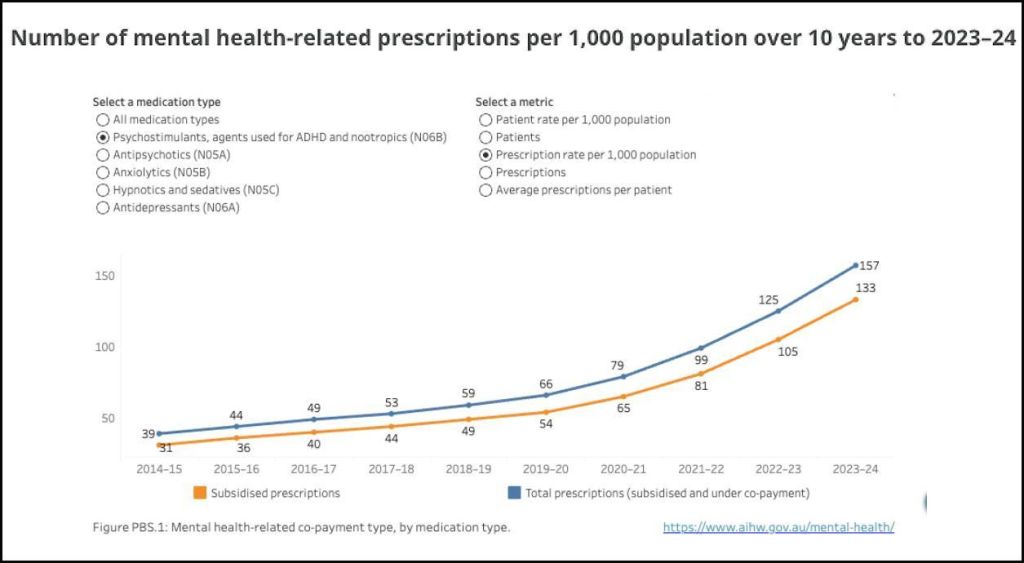
Source: AIHW, May 2025
✅ My last prediction was that the War On Vapes would be fought more vigorously in 2025. Australian governments did indeed significantly tighten vaping regulations in 2025 by restricting all e-cigarettes to pharmacy sales only, introducing strict national product standards that limit flavours and require plain packaging and expanding enforcement powers to shut down illegal retailers.
These reforms coincided with a clear shift in behaviour. New national research shows Australians are less likely to vape than a year earlier, with vaping among 14 to 17-year-olds falling from 18 per cent in early 2023 to 15 per cent in 2025 and the share who have never vaped rising to 85 per cent. Social attitudes have also turned, with young people increasingly describing vaping as “gross” or “cringe,” while exposure to vape ads and social-media sales channels has dropped sharply.
More than 10 million illegal vapes seized since early 2024 underscore the scale of enforcement. Even among 18 to 24-year-olds, vaping rates have edged down. Taken together, these shifts suggest vaping is becoming less common, less accessible and far less socially acceptable in 2025 than it was in 2024.
My final tally stands as follows:
✅13/20
⛔3/20
❓4/20 – most of the unknowns are likely to be ✅
You can see that quite a few of my forecasts seem rather obvious – you knew that we grow older, more multicultural, while housing becomes more expensive.
That’s my point, while the world might seem ever more unpredictable (Trump, tariffs, geopolitics, artificial intelligence, climate change etc), there remains a large number of very predictable future movements.
In your industry, job and investments, make sure to focus on the predictable elements rather than let the unknowns drag you down.
Simon Kuestenmacher is a co-founder of The Demographics Group. His columns, media commentary and public speaking focus on current socio-demographic trends and how these impact Australia. His podcast, Demographics Decoded, explores the world through the demographic lens. Follow Simon on Twitter (X), Facebook, or LinkedIn.
Want to see more stories from InDaily Qld in your Google search results?
- Click here to set InDaily Qld as a preferred source.
- Tick the box next to "InDaily Qld". That's it.