New images as Brisbane’s Olympic stadium architect team announced

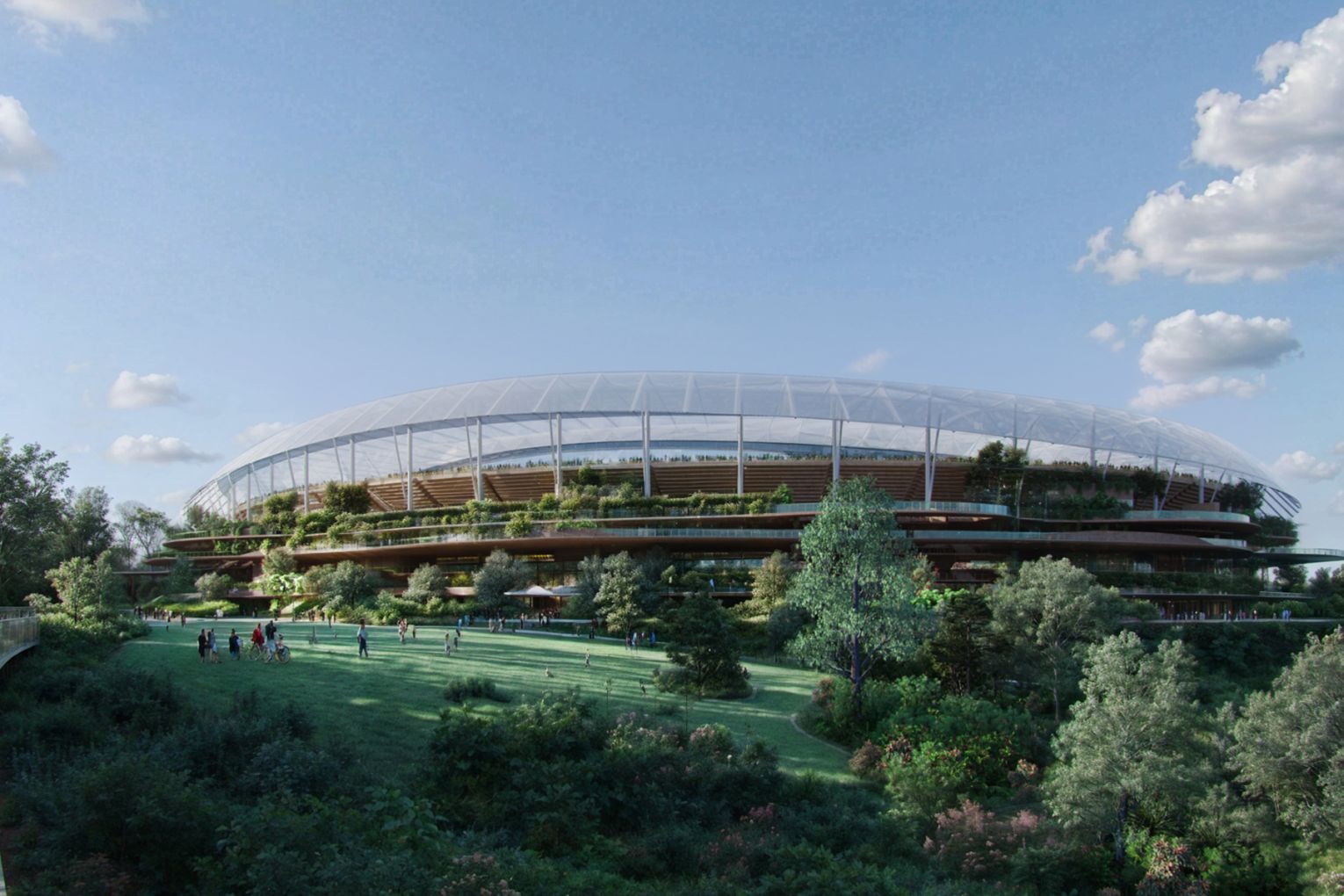
The federal and state governments have revealed the principal architectural team for Brisbane’s Olympic stadium in Victoria Park.
The same team of architects who designed Perth’s Optus Stadium will be in charge of delivering the $3.8 billion Olympic stadium venue for the 2032 Olympics.
Australian-founded firms, COX and Hassell, will partner with Japanese architecture firm, Azusa Sekkei to deliver the 63,000-seat design, the Queensland and federal government’s have revealed.
Alongside Perth’s Optus Stadium, the same architects also delivered the redeveloped Adelaide Oval and the 2006 MCG redevelopment.
Japan’s Azusa Sekkei has designed 120 stadiums across the world, including the Japan National Stadium in Tokyo for the 2020 Olympic and Paralympic Games.
Federal Infrastructure and Transport Minister Catherine King said the stadium’s Queenslander-inspired design will make it a landmark venue for the city.
“GIICA will now commence early design work, alongside project validation work, to ensure the new stadium can be delivered on time and on budget, ready for 2032,” King said.
Brisbane’s Olympic stadium will host the opening and closing ceremonies and athletics for the 2032 Games, before becoming a home for Brisbane Lions, Queensland Bulls and Brisbane Heat post Olympics.
You might like
Queensland’s Deputy Premier Jarrod Bleijie said earthworks for the stadium project would start in mid-2026.
“COX, Hassell and Azusa Sekkei have developed a design concept that celebrates the best of our unique Queensland lifestyle and character in a truly magnificent vision for our stadium,” Bleijie said.
GIICA chairman Stephen Conry AM, said the chosen architectural team “possess the appropriate experience in stadium design, alongside outstanding local knowledge and placemaking expertise, plus the added global resources that will be required for a project of this significance”.
GIICA will deliver 17 new and updated venues across Queensland as part of the $7.1 billion Games Venue Infrastructure Program, funded by the state and federal governments.
The architecture firms selected after a three-month process led by GIICA which began with a call for Expressions of Interest in September.
The architectural team will be supported by leading engineering firms, Arup and sbp (Schlaich Bergermann Partner) to design the stadium’s roof.
COX Architecture director Richard Coulson said the stadium’s design would foster connection with the surrounding landscape of Victoria Park.
“The importance of long views, capturing cooling breezes, and the essential provision of shade, all embody the relaxed way of life that Queenslanders cherish – qualities that are integral to our culture,” Coulson said.
Subscribe for updatesThe design’s concept is a “Queensland Response” for a new venue that will blend the main Olympic stadium with Victoria Park’s topography, he said.
Save Victoria Park (SVP) has long been campaigning against the construction of an Olympic stadium on the culturally significant land of Victoria Park.
Today, SVP responded to the stadium plan news with a claim that Brisbane was shaping up to be history’s most environmentally destructive games.
SVP spokesperson Rosemary O’Hagan warned that plans for the new Olympic stadium would obliterate native wildlife, ancient trees and rolling hills.
“We would remind the Crisafulli government there are legal applications requesting permanent protection of the park currently being evaluated under the federal Aboriginal and Torres Strait Islander Heritage Protection Act,” O’Hagan said.
SVP claimed that it had been advised that GIICA intends to send excavators into Victoria Park in the coming months, with up to 66 percent of the park expected to be impacted by construction.
“Having broken election promises and tossed aside 15 acts of parliament, the Crisafulli Government is now acting as if its contractual agreements also don’t apply,” O’Hagan said.
New data also showed that the cost of the new stadium sits closer to $4.4 billion rather than the expected $3.8 billion due to soaring inflation forecasts across southeast Queensland.
SVP will team up with Patches of Hope, a breast cancer awareness fabric line, to host a “Creatives in the Park” campaign event opposing the stadium plans on Saturday January 31.
O’Hagan says there was still time to go back to the original Olympic brief, which allowed for Victoria Park to remain Brisbane’s largest designated green space.
“Adapt the Games to Brisbane, and not the other way around. Let Victoria Park become the truly amazing green destination that was long promised to the people of this city,” O’Hagan said.
Want to see more stories from InDaily Qld in your Google search results?
- Click here to set InDaily Qld as a preferred source.
- Tick the box next to "InDaily Qld". That's it.