Book review: Scared Angry Laughing: or How to fix the world
This collection of short essays sees Margaret Merrilees reflect on the past and the future, from her memories of Adelaide’s queer community to facing arrest after joining anti-Santos climate protests.
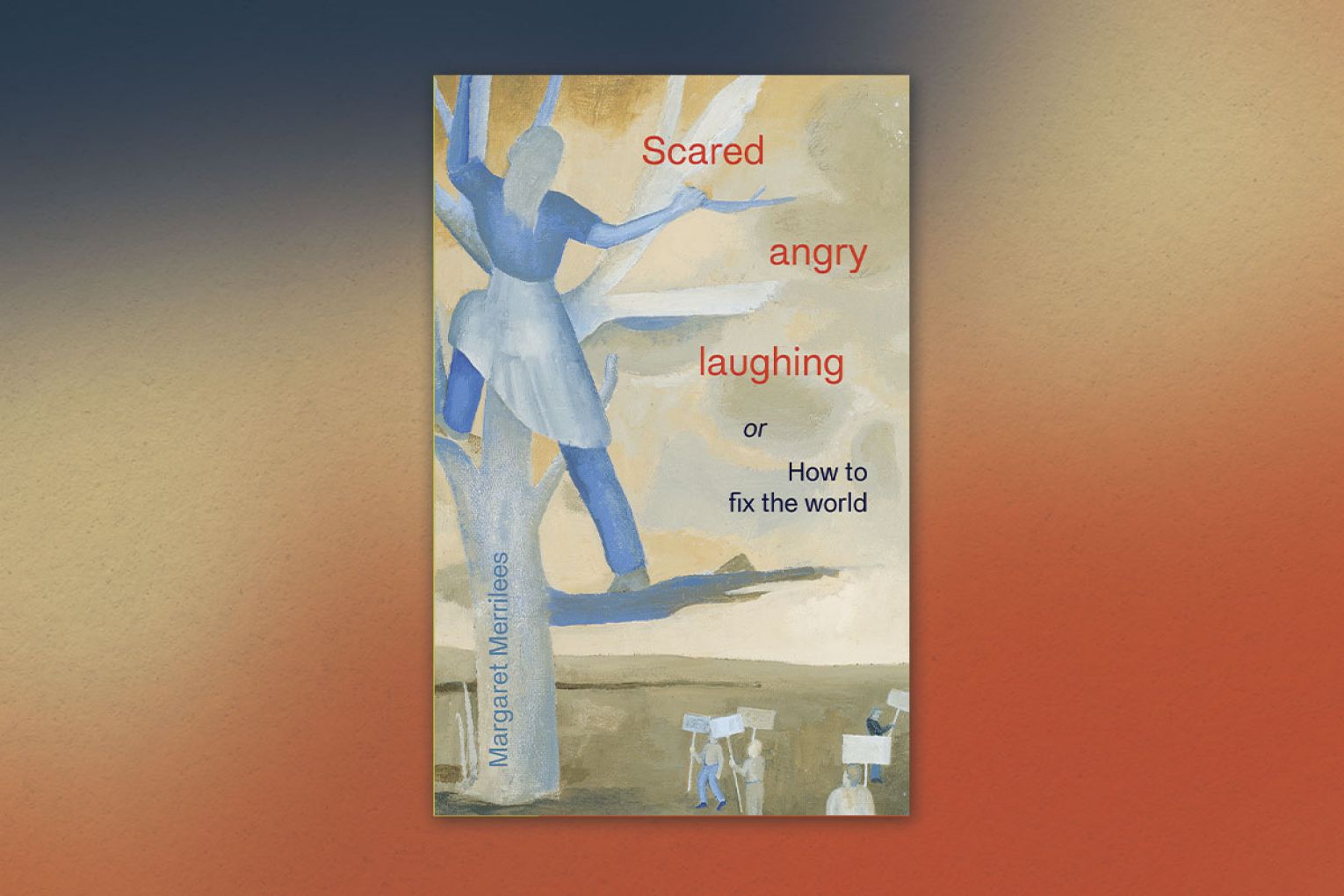
Margaret Merrilees is a prolific and versatile writer, having published five books in twelve years. Her debut novel, The First Week, is a quiet story of familial love, grief and connection to land, and was shortlisted for the Barbara Jefferis Award and the Glenda Adams New Writing category of the NSW Premier’s Literary Awards in 2014; her follow-up novel, Big Rough Stones, deals in similar themes. She’s also published two humorous graphic-ish novels about the adventures of two lesbian grannies, Fables Queer and Familiar and Further Fables Queer and Familiar, which began as weekly online serials and was also broadcast on radio.
Now, she’s turned her pen to a book of short essays called Scared Angry Laughing, which combines the grief and the humour, the land and the lesbians, and makes for highly entertaining and seriously digestible reading about urgent and uncomfortable topics.
The book opens joyously, with a nameless rollcall of a communal ‘we’ made up of young, fierce lesbians who descended on Adelaide in the late 70s and early 80s:
“We lived in cheap old stone houses with cracked walls, draughty doors and windows, gardens with lemon trees and chooks. They were big communal households, four or five residents, plus a floating population of visitors, lovers and travellers passing through. The roles weren’t fixed. Travellers became lovers, lovers became residents, residents passed through. I’ve got a crush on every woman in this house tonite, said the housebook.”
Eventually Merrilees grew older and mellowed (though never settled). She became monogamous. She forgave and befriended straight men. She grew older still, lost her hearing, and stayed. “Did we think we would change Adelaide?” she asked of her younger self and her team of co-conspirators. “I doubt we foresaw how Adelaide would change us.”
You might like
It couldn’t be more fitting that the publisher of this book is Pink Shorts Press, who prefer accessible, feel-good, short and quirky, underrepresented forms of writing, like short fiction, memoir and essays, and who are proudly South Australian, very ‘Adelaide’, their name referring to the summer attire of former Premier Don Dunstan, whose administration decriminalised homosexuality. In fact Dunstan is named in this glorious opening essay about Adelaide, titled ‘A place in the sun’.
It’s clear early on in the book that Merrilees goes where most people wouldn’t – like to the Down Under Tour with nine other pension-aged women who bare their breasts and bums to protest the event sponsor, Santos. That, and her subsequent arrest, received a lot of media coverage, garnering laughable comments from news subscribers, such as, “Well, that’s a bit cheeky”.
Such bravery and brazenness would surely transfer to her writing, and it does, as evidenced by some of the essays’ topics. For instance, an old woman talks to two young, giggling boys about not only sex but lesbian sex. And another: some might say the revolution for women’s rights began with the invention of the tampon, but first: old woman schools her readers on pads, telling us in her day, at school, girls dropped the soiled ones into an incinerator.
Scared Angry Laughing is full of these anecdotes and they’re very funny, but what Merrilees is talking about is essentially not amusing at all: the extinction of our planet, non-heterosexual recognition and equality, reproductive health lifted from patriarchal squeamishness and intolerance and taken seriously. But as she writes in an essay about suicide, war and other catastrophes, changing the world is “not all marching round with placards”. It can also be writing an earnest book with a light approach, and making people laugh during the end of days, when we’d otherwise cry.
Subscribe for updates
The same subjects show up again and again, led by new anecdotes and twisted ever so slightly to make an original point. Aging is one (she looks forward to reaching the age where her breasts sag so much she’ll finally be able to tuck them into her pants) and, most touchingly, hearing loss another. In an essay about learning languages – briefly Spanish and specifically Auslan – Merrilees writes:
“Here’s a string of English: When I’m writing, I aim to express everything relevant about life and the universe in one brief sentence. I don’t like excessive descriptions or ponderous paragraphs.
If I were to sign this in my rudimentary Auslan, it would become something like: me writing love short, don’t like waffle.”
As she goes on to tell us how her face and fingers move to translate said sentiment, we see an original device to help us understand the structure of Auslan at work, how it looks and how it reads, but also a character sketch of the writer Margaret Merrilees correctly self-critiquing her writing style. Soft and somewhat eccentric flourishes like this invite readers in while fleshing out her intentions.
With each essay lying between the four- and eight-page mark, Merrilees manages to dig in deeply yet simply, poking topics like the choice to not have children or the choice to submit to voluntary dying with a twig rather than a pitchfork. In the end, twigs are safer and easier to handle than pitchforks, and they’re compostable. Though I’m not sure Merrilees can actually ‘fix the world’, as the book’s subtitle suggests, with either twig or pitchfork, I think she’s proven that she’s had, and still is having, a solid crack.
Scared Angry Laughing: or How to fix the world (Pink Shorts Press) is out now
Want to see more stories from InDaily Qld in your Google search results?
- Click here to set InDaily Qld as a preferred source.
- Tick the box next to "InDaily Qld". That's it.
Free to share
This article may be shared online or in print under a Creative Commons licence