Book review: The Enigmatic Echidna
South Australian zoologist Danielle Clode tackles her prickliest subject yet: getting up close to the quilled monotreme with backwards feet, a tendency to hibernate when things get tough, and a leathery snout for snorting ants.
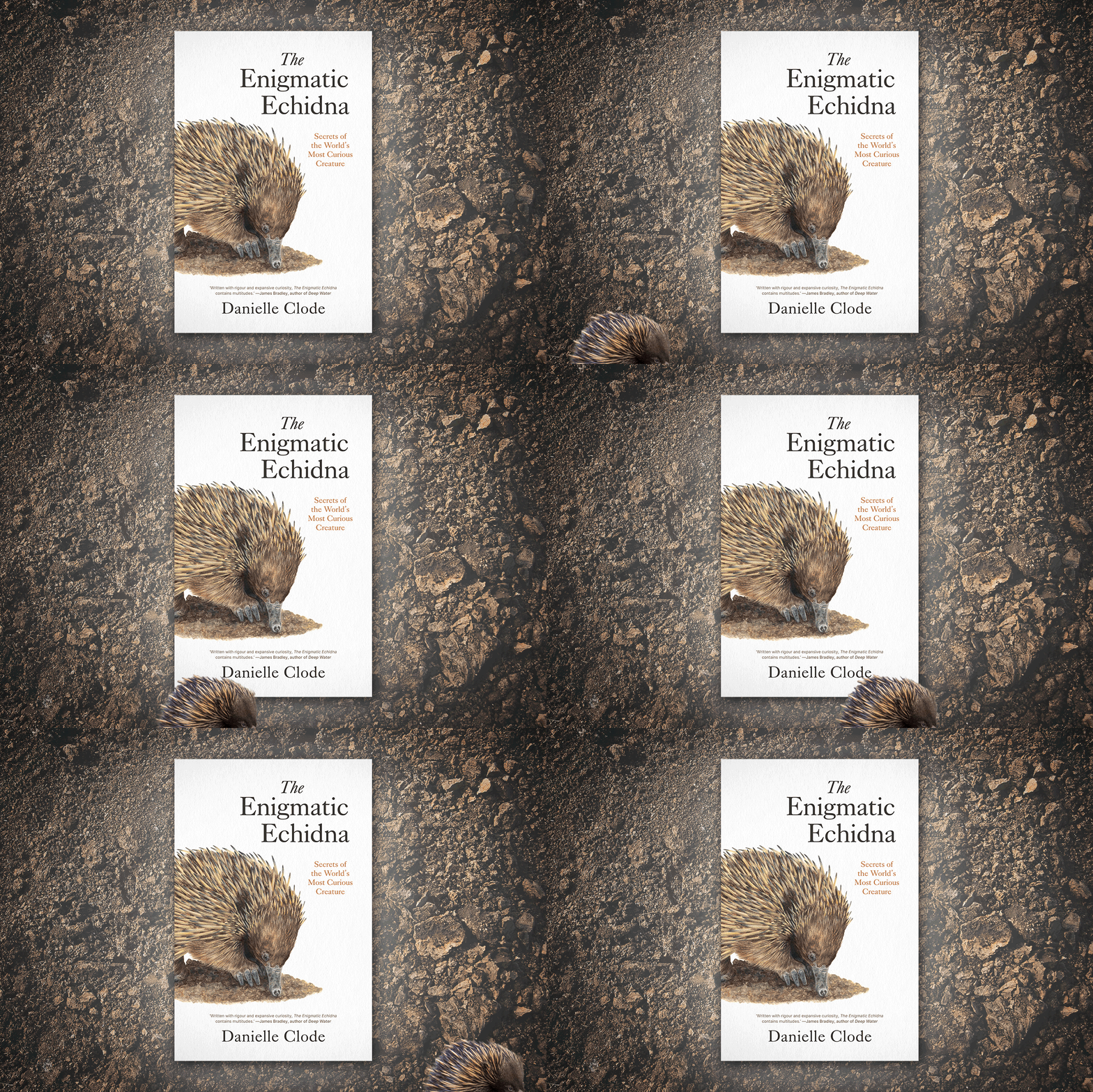
They may be Australia’s most widespread mammal but coming across an echidna in the wild is so rare that even Danielle Clode counts her good fortune when one crosses her path.
They are so solitary they sometimes have trouble finding each other, except in mating season when the males form a cooing echidna train behind the fertile female, hoping to be picked. Clode’s own attempt to find one for the purposes of this book ended in failure because echidnas are never where you want them to be. In New Guinea where he researched mammals for 15 years, scientist Tim Flannery saw only one echidna, while researcher Peggy Rismiller on Kangaroo Island calculated that it took one person three hundred hours of observation for each sighting of a short-beaked echidna. The long-beaked ones are apparently hard to find.
This makes them difficult to study but Clode, in this colourful and personal appraisal of their surprising features and habits, goes back through the biological record, with the first known description in 1792 from an assistant keeper at the British Museum. The flat and lifeless animal recorded, accurately enough, the state of a dead echidna but a better description the same year came from William Bligh in a letter to botanist Jospeh Banks. Their mystique only grew a century later when it was understood the echidnas were in that rare category of monotreme, a mammal that not only laid eggs but also suckled its young – who are known rather enchantingly as puggles.


This insider’s view, a companion to Clode’s Koala: A Life in Trees, comes into its own when we meet individual echidnas who present in a full range of personalities. One long-beaked example, held captive in London for 26 years early last century, was so defeated and anti-social its keeper said, “It’s just about alive, and that is all you can say for it.” Contrast this with young Willo who at five months was brought to a sanctuary in New Guinea and became so friendly he presented for chest scratches and being brushed. JR, named after the character in Dallas, lived happily at Taronga Park Zoo and would splash around each morning enjoying a bath then for breakfast pin down an earthworm with his feet and suck it up his snout like spaghetti. Others can’t wait to leave, including one who hid for five days then started planning his escape. Each day he would prise up bricks from the floor and dig a tunnel or try to scale the wire walls using his snout as a fifth limb. After three escapes he was set free.
One of the best places to be sure to see an echidna is on our doorstep at Cleland Wildlife Park which currently has five, all of them rescues. The smallest, Ethel, just survived the 2019 Cuddlee Creek bushfire and arrived with burns to her belly and feet, melted spines and damaged claws. She was found barely alive and brought to Bev Langley at Minton Farm Animal Rescue where she endeared herself to Langley by waking up for her formula when her enclosure was tapped. “So very clever,” Langley said.
You might like
They are known to hibernate sometimes but not always and can sometimes fall into a state of hibernation when life gets too much. This caused some alarm, with the echidna known as Slick brought in smothered in oil after being found in the sump of a motor repair shop. He was so tricky to clean it was decided to sedate him for short periods but on the third attempt, he failed to wake up. After a moment of panic, the vet realised he had lapsed into a torpor where he stayed for two weeks then woke up and carried on as though nothing had happened.
Despite their elusiveness, Clode captures what incredible and mysterious creatures echidnas are, eating up to 40,000 ants a day and mating, as expected, with some difficulty and occasionally while one is asleep. They are also surprisingly strong and smart, and no one quite knows why their brains show such large capacity for higher-order thinking.
Clode concludes they must need all that brainpower just to keep themselves alive in a complex and unpredictable world but really, who knows what an echidna thinks?
The Enigmatic Echidna: Secrets of the World’s Most Curious Creature (Black Inc.) is out now
Want to see more stories from InDaily Qld in your Google search results?
- Click here to set InDaily Qld as a preferred source.
- Tick the box next to "InDaily Qld". That's it.
Free to share
This article may be shared online or in print under a Creative Commons licence