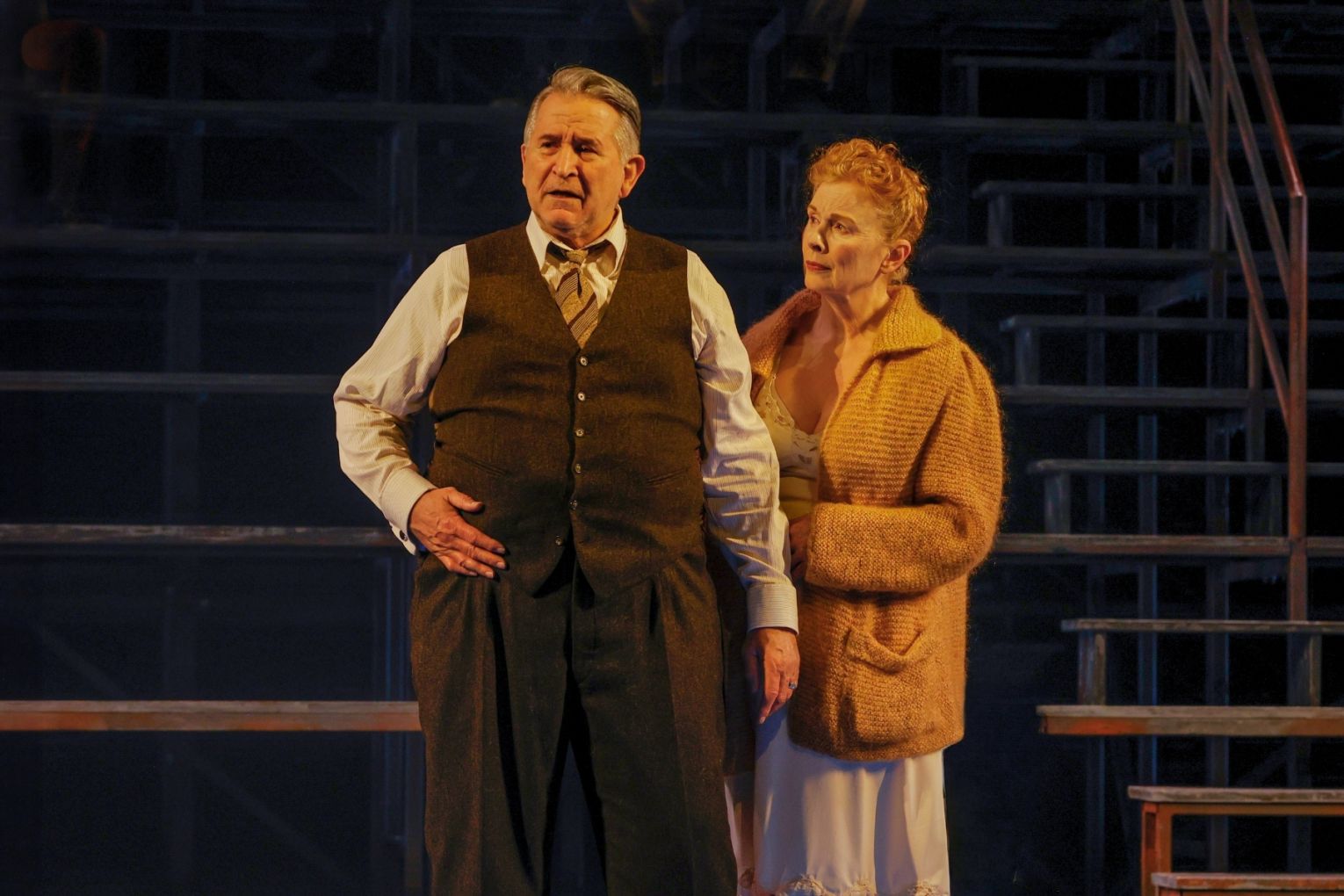
It may be the great American play but there is also something rather Greek about Death of a Salesman.
For a start it was playwright Arthur Miller’s visit to a Greek amphitheatre outside Syracuse in Sicily that inspired him in more ways than one.
Neil Armfield is the director of the latest touring production, which opened at QPAC on Sunday afternoon. At 3pm. Funny time for the opening staging of a three-hour play.
(Yes, three hours. “It feels more like Long Day’s Journey into Night” I quipped as I took my seat. Well, I thought it was funny.)
In a message from Armfield in the program he points out that Miller’s Greek amphitheatre experience was “a vision of a national theatre that was both popular and poetic, where the tragic form gave shape and meaning to life”.
A word derived from the Greek comes to mind. Catharsis – “made famous by the Greek philosopher Aristotle in his work Poetics to describe how watching a tragedy purges heavy emotions like pity and fear in an audience”.
And that holds true today for this extraordinary play. If a musical goes for three hours it seems like three days, but this three hours passes easily, the same way those three hours watching Christopher Nolan’s The Odyssey did for us recently.
Because a play such as this is why one wants to go to the theatre. It is tough, clear writing and perfectly understandable to pretty well anyone.
You might like
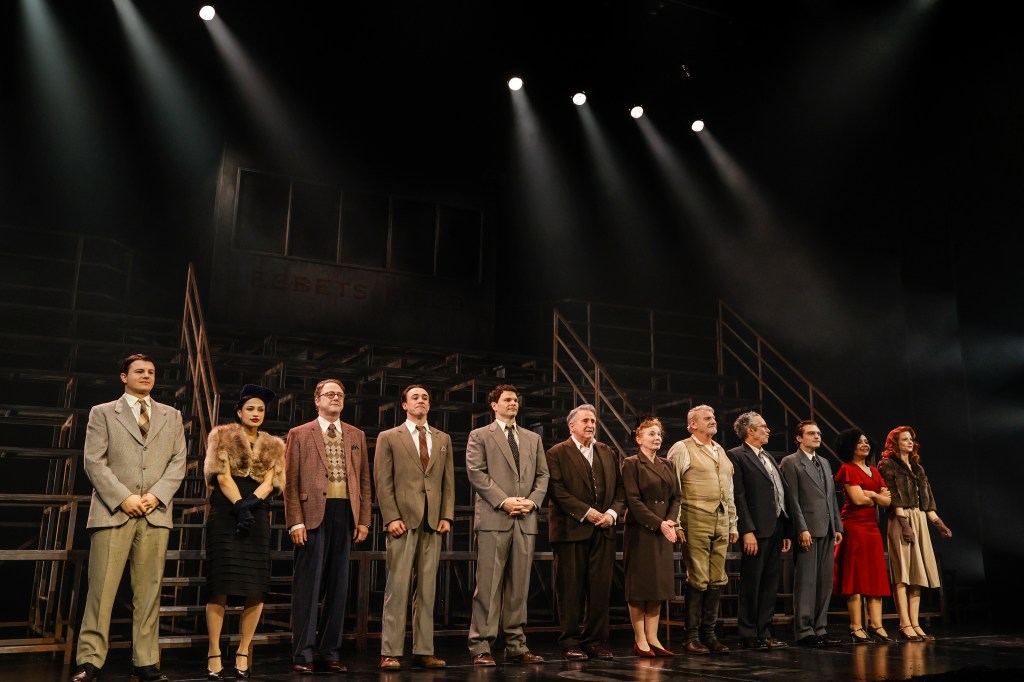
It features a star-studded Australian cast including Golden Globe, Emmy and Tony award-winning actor Anthony LaPaglia as the tragic travelling salesman Willy Loman, and Silver Logie and Helpmann Award-winning actor Alison Whyte as Willy’s devoted wife, Linda.
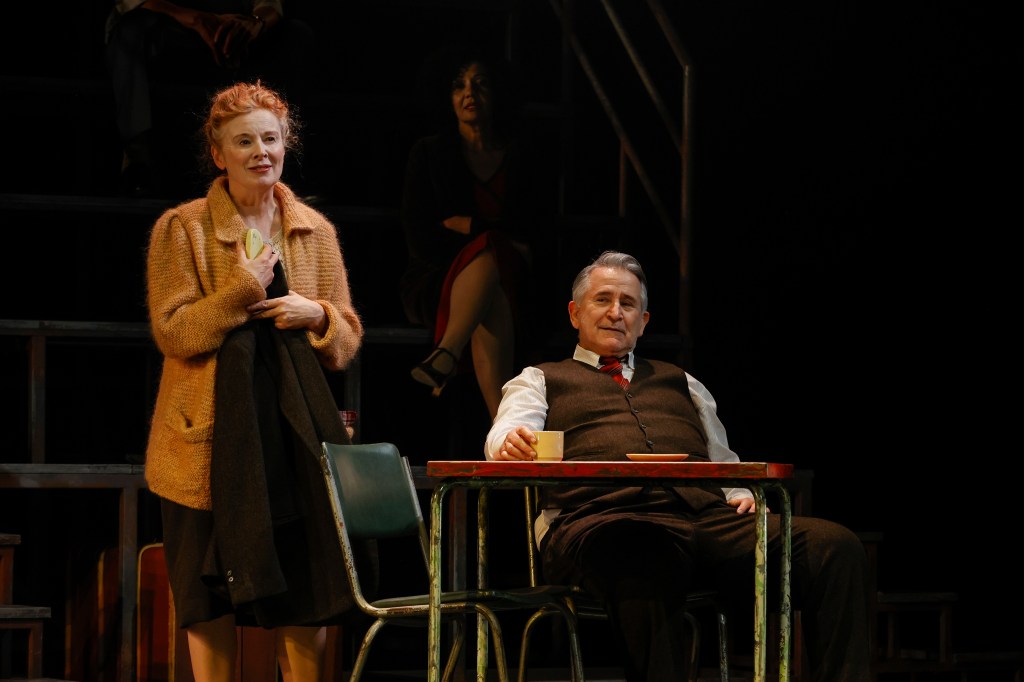
Josh Helman plays Biff Loman, a famous failure, and Ben O’Toole is Happy Loman, a ne’er do well with delusions of grandeur. These two sons are a constant disappointment to their parents, which is part of the tragedy. Also nice to see Anthony Phelan back on stage in Brisbane as Willy’s brother, the ghostly Ben Loman.
LaPaglia expressed his delight to be returning to the role of Willy Loman in Armfield’s outstanding production, which LaPaglia played to rave reviews in Melbourne, Sydney and Perth in 2023 and 2024.
“Arthur Miller was the presiding genius of American theatre in the 20th century and Death of a Salesman is arguably his finest achievement,” LaPaglia says. “I was lucky enough to meet and work with Arthur when I played Eddie Carbone in A View from the Bridge on Broadway in 1997 and I feel a deep affinity for his work.
The inevitability of tragedy hangs like the Sword of Damocles over the stage
“The story of Willy Loman is simply one of the greatest roles ever written and remains timeless in its creation of the tragic unravelling of a man’s identity after years of neglecting his relationships and true self-fulfilment. You see the effect this has on his devoted wife and the shattered relationships with his sons.
“It also speaks profoundly to the American Dream and, in many ways, foreshadows the dissolution of that dream in the 21st century. Even after 77-years, this play, like all great classics, is as powerful and relevant as ever. I cannot wait to finally bring it to Brisbane audiences.”
The inevitability of tragedy hangs like the Sword of Damocles over the stage and though we know where it is all going it’s still a shattering experience. Part of the tragedy is that in flashbacks we can see where it all went wrong and how that might have been averted.
But Willy Loman is flawed and stubborn and his doom seems like some sort of twisted destiny.
Subscribe for updates
And Biff, poor Biff, is the greatest loser in American drama and literature.
If you’re a Seinfeld fan, you’ll understand how much this play is part of the American psyche. Seinfeld is riddled with references to the play, mainly when the character George Costanza exhibits his traits as an underachiever. In these instances, Jerry Seinfeld refers to him as “Biff”. It happens on numerous occasions.
There’s also an hilarious episode in which the character Kramer is talking about a completely fictional interaction with Arthur Miller regarding his masterpiece.
“So, I said to him, ‘Arthur, Artie, bubala, why does the salesman have to die? Change the title. The Life of a Salesman. That’s what people want to see’.”
Which is kind of missing the point, but it does demonstrate how fixed this play is in American culture.
All the performances are terrific. LaPaglia’s Willy is a masterclass, and Alison Whyte is devastatingly good as the mother who berates her sons as “animals” for disrespecting their father at one point in the play. Josh Helman is excellent as Biff and O’Toole is also terrific as Happy and both boys are in need of a few good swift uppercuts.
The play gains momentum after interval, tragic momentum.
It’s interesting that while Willy Loman is a salesman we never find out what he is selling. It doesn’t really matter, though. What he has been sold, however, is clear – it’s the American Dream, a soiled American Dream at that.
“The American Dream has consumed much of the world to the profit of a small cohort of thieving, murderous adventurers,” Armfield writes in the program. There’s the irony.
And as he points out, the irony is even more bitter in those iconic last words by Linda Loman at Willy’s graveside: “We’re free.”
Death of A Salesman plays the Lyric Theatre, QPAC, until September 6.
Want to see more stories from InDaily Qld in your Google search results?
- Click here to set InDaily Qld as a preferred source.
- Tick the box next to "InDaily Qld". That's it.
Free to share
This article may be shared online or in print under a Creative Commons licence