Drawn from the heart of Country
Fresh individuality is inherent in an exhibition of paintings from inland Australia now showing at Edwina Corlette Gallery in Brisbane.
The paintings that emerged from the small settlement of Papunya in the early 1970s are credited with the translation of ancient creation stories onto canvas using acrylic paint, stimulating the contemporary Western Desert movement.
Almost 60 years later, the community-based arts organisation Papunya Tjupi, founded in 2007 in Papunya, is building on the legacy of the original 1970s Papunya Tula cooperative.
For gallerist Edwina Corlette, Candy Nelson Nakamarra’s work stood out from her first viewing. Corlette has subsequently made the long trip to remote Papunya, most recently last year, driving on significant stretches of unsealed road outside Alice Springs.
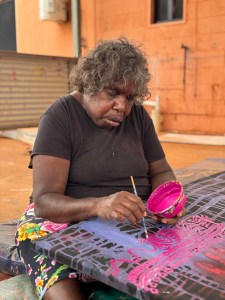
The first time Corlette met Nelson Nakamarra, 61, at Papunya, in the Northern Territory, she offered the artist an unusual exhibiting opportunity. In 2022, Nelson Nakamarra’s work was shown at Edwina Corlette Gallery with Miranda Skoczek and Dan Kyle under the title Common Ground, exploring their shared abstract qualities. (Skoczek and Kyle are non-Indigenous).
You might like
In Artist Profile magazine’s June 2022 issue, Kyle described the ambition for this group show as one “devoid of race, gender and background … purely based on the coming together of three artists who share ways of exploring experience and storytelling through a similar visual language”.
Nelson Nakamarra’s visit to Brisbane on that occasion was memorable. In conversation with the other artists she described the way her artistic vision fused with her stories, Country and experience.
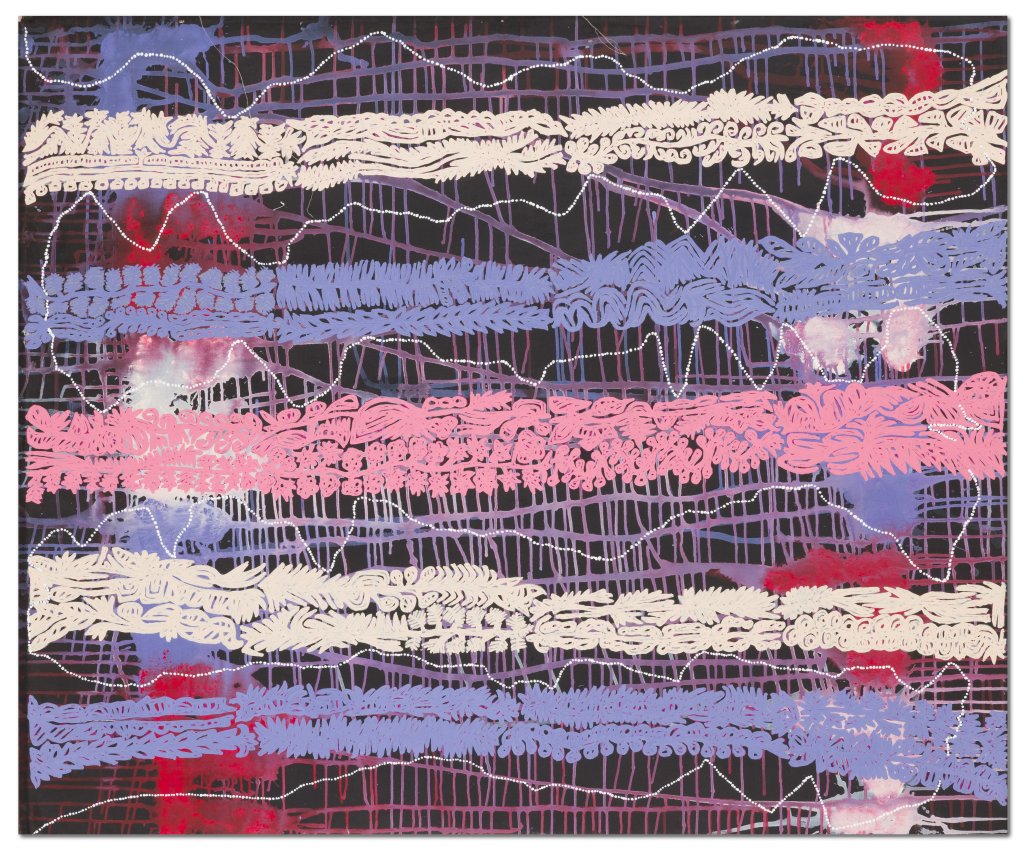
Nelson Nakamarra’s subject for both the 2022 and current exhibition is Kalipinyipa, her Water Dreaming story that relates to a sacred site near Kintore, in the Territory.
Water is central to her process. Canvases begin with dribbled, water-infused paint that runs across primed surfaces in many directions. The next layer is raindrops, before the lacey, drawn sections that relate stories of women’s activities are overlaid – making damper, collecting seeds – with the painstaking and delicate nature of these pursuits echoed in patterns that partially cover, like lacey lichen, the lower layers.
Subscribe for updates
The resulting surface is lively and organic, with colour and pattern that draws the eye into its depths. Its movement and variability reminds me of the reflections and distortions you see looking into a rocky creek.
Many of the Papunya Tjupi artists are, like Nelson Nakamarra, direct descendants of the first generation of Papunya painters. However, while Nelson Nakamarra watched her father, renowned Papunya Tula artist Johnny Warangkula Tjupurrula (1925-2001) paint during her childhood, and acknowledges his painting and its traditions, she asserts: “I paint my way.”
Dan Kyle, who visited Nelson Nakamarra in Papunya with Corlette, sees in the cross-over of the lines of watery paint and its motifs a sense of the landscape from above, “the watercourses, waterholes and sand dunes”.
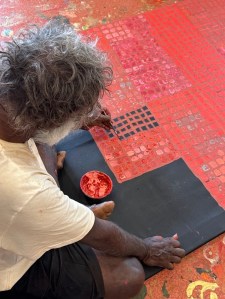
In this exhibition her work is paired with that of Carbiene McDonald Tjangala, 64, also from Papunya Tjupi. His Four Dreamings paintings relate stories learnt from his father, Snowy McDonald, a Pintupi-Pitjantjatjara man who lived in Papunya. While McDonald Tjangala’s paintings contrast with Nelson Nakamarra’s organic and meandering lines, they share this highly individual approach to their painting.
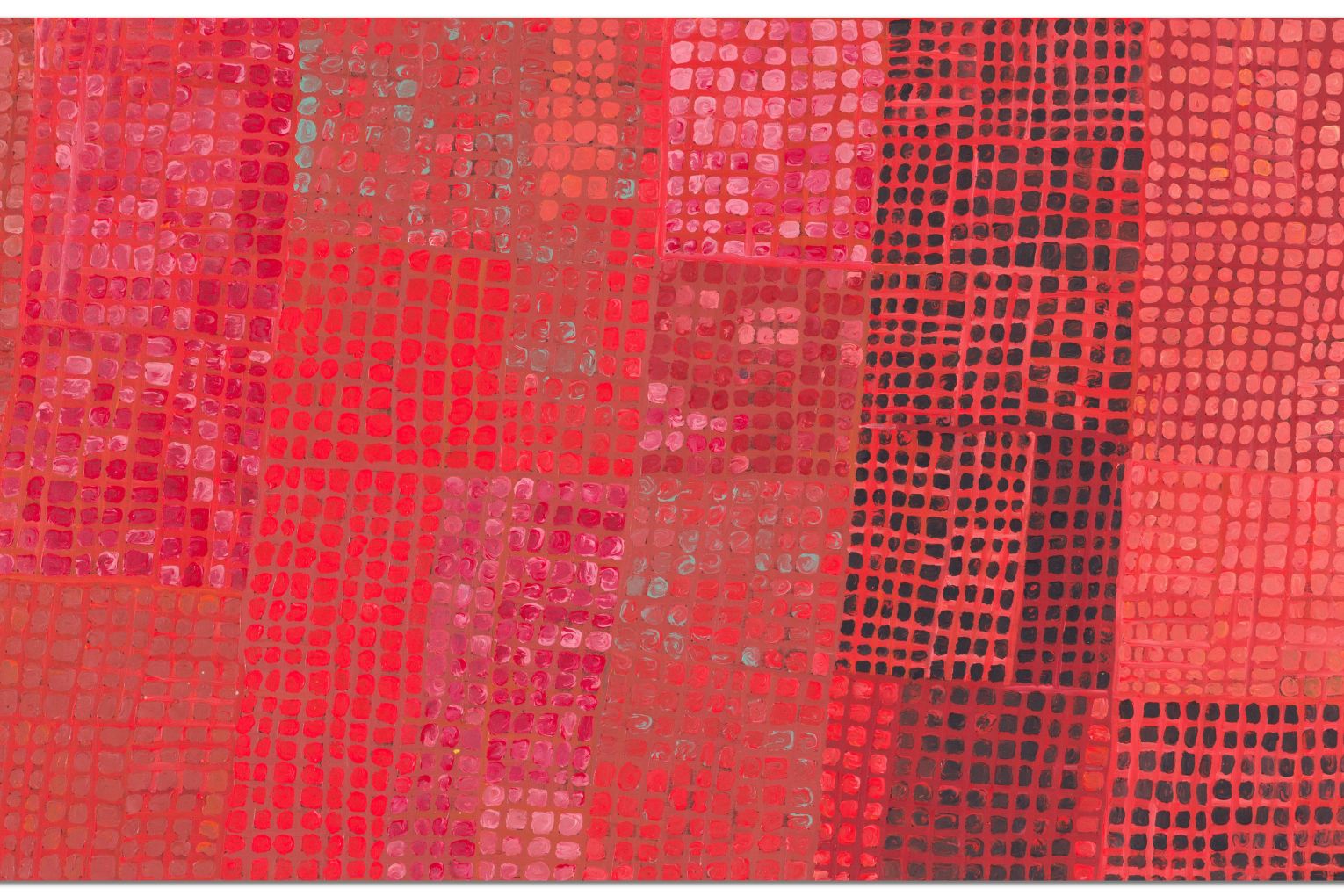
His paintings are based on a loosely gridded layout, with coloured squares creating rhythmic surfaces that adhere to the soft structure. Colour carries both strength and subtlety to enliven the surface, with individual squares often carrying multiple hues. At times the colours are muted – neutral black and cream with hints of yellow that interact across the surface – and in others are dramatic: red tones with pink and black used to define the squares. These works convey his knowledge of four ancestral sites at significant waterholes – the Petermann Ranges, Docker River, Kalaya Murrpu (Blood’s Range) and Mulyayti, near Kata Tjuta. There is, in his regular patterning, a sense of the red pebbly dirt of his Country seen from above, as though exhibiting his knowledge from the ground up.
Both artists began painting later in their lives, Nelson Nakamarra in 2009 and McDonald Tjangala in 2018. His work was awarded the prestigious Hadley Art Prize (Hobart) in 2019, and Nelson Nakamarra won the Interrelate Prize of the Wollotuka Acquisitive Art Prize, University of Newcastle in 2012.
Together these two artists demonstrate the fusion of the past and the future. Powered by an awareness of their Country, stories and traditions they are able to forge fresh new horizons.
Kuwarritja Irriitinguru – A Way Before and a Way Now: Candy Nelson Nakamarra and Carbiene McDonald Tjangala continues at Edwina Corlette Gallery, New Farm, until February 24.
Want to see more stories from InDaily Qld in your Google search results?
- Click here to set InDaily Qld as a preferred source.
- Tick the box next to "InDaily Qld". That's it.
Free to share
This article may be shared online or in print under a Creative Commons licence