Storylines ease the way to real advances in reconciliation
Birrunga Gallery in Brisbane is marking National Reconciliation Week with an exhibition advancing the idea through stunning artworks.
An exhibition at Birrunga Gallery in Brisbane marking National Reconciliation Week speaks volumes about where we are on a long road. That road to reconciliation is rocky and winding at times but it can be made easier to travel through art.
In fact, Indigenous art is one of the great revelations of recent decades as artists have found ways of telling their stories in the most diverse and engaging ways. Art has bridged a gap in understanding (to a degree) in so many ways and Australian Indigenous art is now celebrated globally.
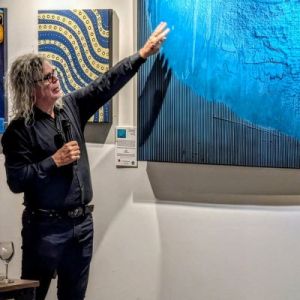
We are lucky to have Birrunga Gallery to help us navigate this world. It is more than a gallery however thanks to the entrepreneurial spirit of its lead artist and the man behind the business, Birrunga Wiradyuri.
The gallery showcases contemporary Indigenous art, offering a space for First Nations artists, cultural education and community engagement. It presents a range of artistic expressions, including painting, music, dance and artefacts, alongside exhibitions, tours, workshops and storytelling sessions.
Birrunga, as we know him, is an inspiring artistic leader as well as a fine artist in his own right.
Birrunga Gallery also branches out far beyond the gallery space with stunning public art projects including creating work for a number of the train stations on the new Cross River Rail project.
You might like
The gallery and café/restaurant is an Indigenous hub in Milton, part of the Milton Green precinct after moving from the CBD a year ago. Walk in there today and you are surrounded by a variety of intriguing works by emerging and established artists.
The theme for this National Reconciliation Week exhibition is All In For Reconciliation and Birrunga describes it as “aspirational in the extreme which has the effect of washing over the practical, historic, contemporary, tangible and intangible realities of the task at hand”.
‘The challenge … was to develop a series of works imbued with the emotion, perspectives, observations and cultural narratives of their generation’
“The challenge then is to identify what the landscape actually is, to identify the perspectives, sources of intelligence and begin to understand that landscape with a view to something practical and workable,” he says. “The insistence on aspirational themes in regard to reconciliation is dated and has the unfortunate effect of unintentionally feeding the deficit narrative and or presenting skewed data that illustrates false positives.
“That needs to change. The challenge then for the artists of the Birrunga Gallery Cultural Creative Development Program was to develop a series of works imbued with the emotion, perspectives, observations and cultural narratives of their generation on the subject at hand. The contributing First Nations artists’ ages range from 18 to mid-20s.”
It’s helpful to have articulate didactic panels to navigate the works. Of course, they speak for themselves on the one hand, but to have these explanatory words to mull over while you browse is helpful and inspiring.
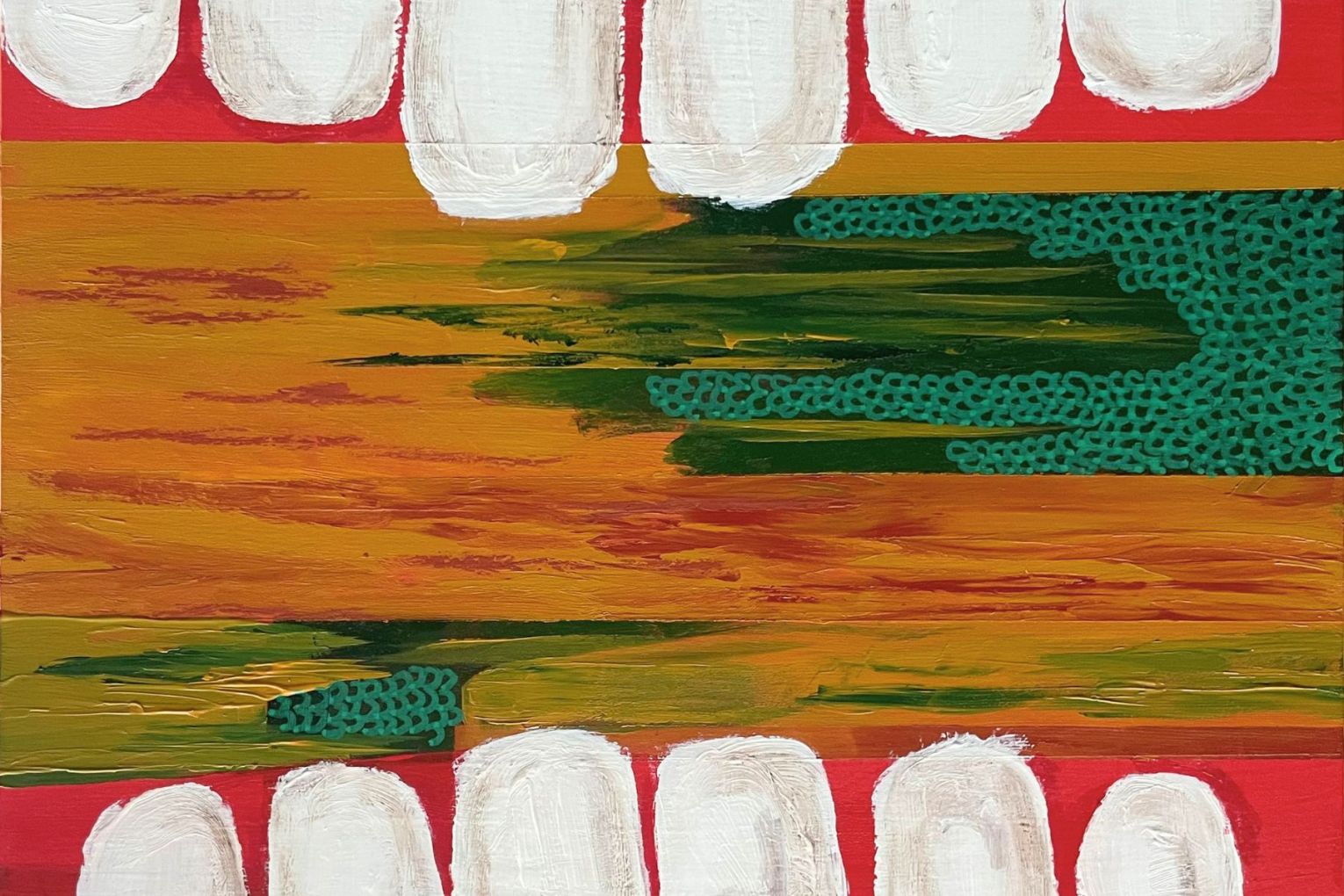
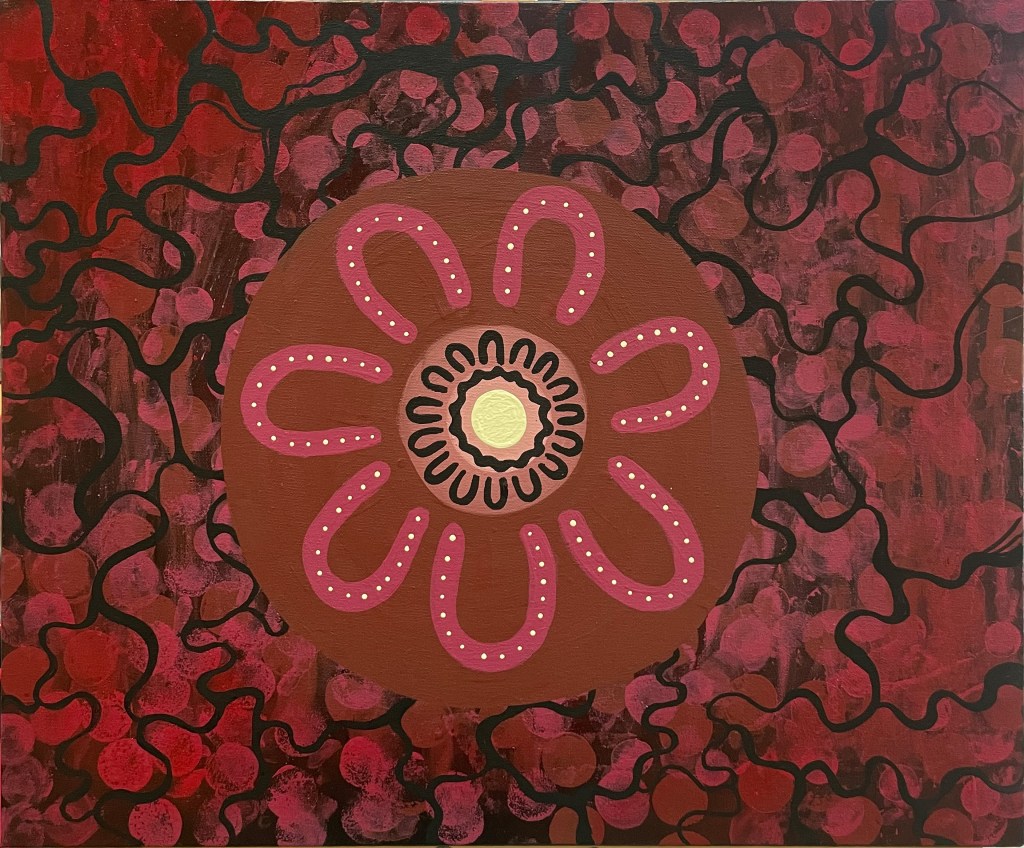
Grace Naveikata’s acrylic work Spoke, for example, “reflects on the power of communication within community ad the role of oral storytelling as one of humanity’s earliest forms of storytelling. The work invites audiences to peer into an open mouth, symbolising the act of passing knowledge from one generation to the next.”
Subscribe for updates
I took it as a purely abstract work at first but after reading that I realise that the white fringe is actually teeth. Which is kind of fun.
I loved Elysia Love-Anderson’s Till The End, our blue planet as seen from space.
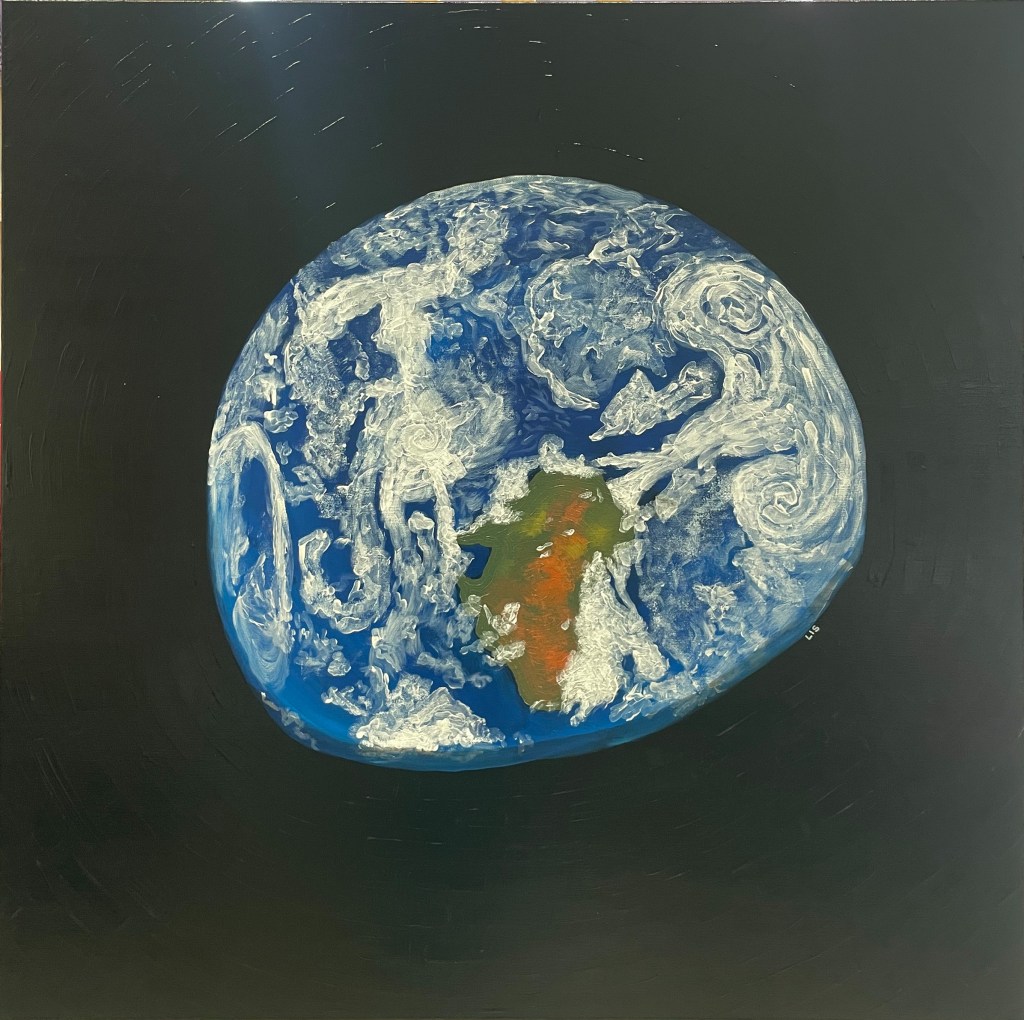
“Till The End was inspired by the recent NASA Trip around the moon, specifically the photograph the astronauts took of Earth with Australia mostly visible,” the artist explains. “When seeing this photo, it put life into perspective for me; we are all just on this tiny ball floating in a vastness of black. Why can’t we choose to understand, respect and share? There’s not much else out there.”
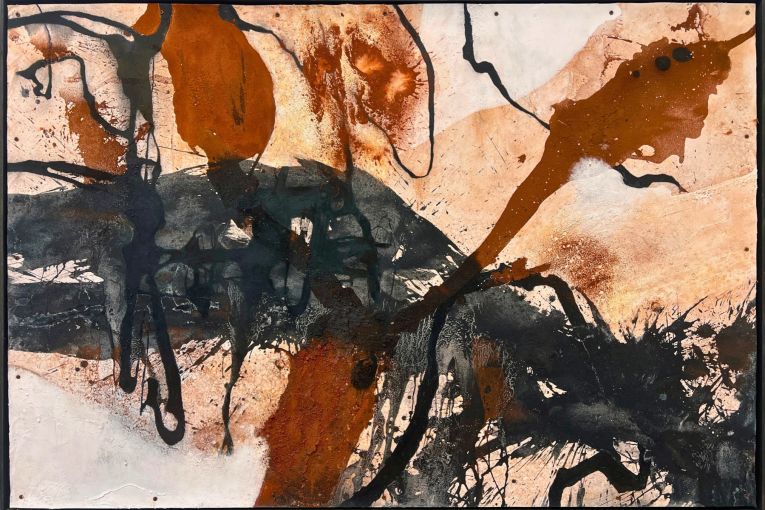
Birrunga Wiradyuri’s major work guwunggan is accompanied by text that is a plaintive call for real reconciliation.
“The way I see it, White Australia has absolutely no idea what the landscape would look like if ‘reconciliation’ was actually put into practice as a committed process. The landscape is awash with the impacts of colonisation,” he writes.
“Those impacts create an illusion of a level playing field. Not unlike the surface of a serene lake. However, underneath the surface is where everyone in the White Oz camp is scared to go. And what remains hidden beneath that surface is a mixture of benefit and liability, much like navigating unsounded waters. So, if reconciliation was going to actually happen and the landscape of reality realised, there’d need to be a series of ’issues’ attended to. Colonisation started in the east and headed west and all points elsewhere.
“So, I’m suggesting that we look at the lines across the bottom as a series of ‘issues’ for the ‘all in for reconciliation’ crowd to work on. So, each dark vertical line is an issue. Land Rights. Stolen Children. Inequity/ies. Criminalisation of culture etc.
“‘As each issue is attended to moving east the landscape of reconciliation begins to reveal itself. The challenge then is for the audience to name the ‘issues’ and see who really is all in for reconciliation. The landscape to the right after the issues are sorted would be something none of us have ever seen. The piece is in my Lore colour, looking down from above.”
It’s a powerful message through art and this exhibition amplifies that call for real reconciliation.
All In For Reconciliation continues at Birrunga Gallery, 19 Cribb St, Milton, until July 3.
Want to see more stories from InDaily Qld in your Google search results?
- Click here to set InDaily Qld as a preferred source.
- Tick the box next to "InDaily Qld". That's it.
Free to share
This article may be shared online or in print under a Creative Commons licence