QUT prepares the next generation for a changing world
From AI and data science to investment and technology, QUT Business alumni are applying the skills they developed at university to navigate rapid change – while industry input is helping shape what comes next.
For business leaders working at the intersection of technology, data and strategy, one thing is becoming increasingly clear: keeping pace with change is about more than understanding the latest technology.
It is also about knowing how to ask the right questions, interpret information, communicate ideas and apply new tools thoughtfully to real-world problems.
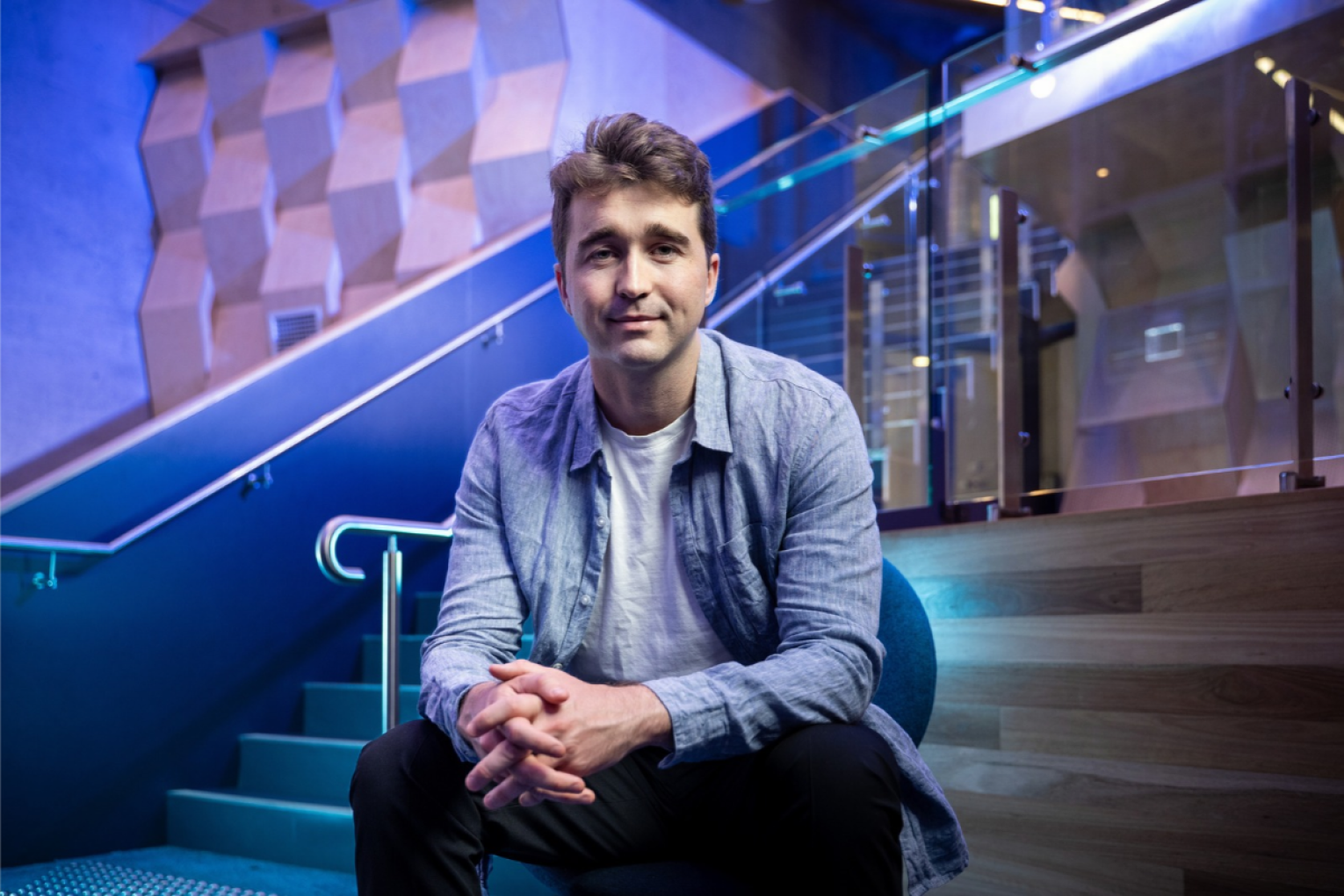
For Queensland University of Technology (QUT) Business alumni Nick Munro and Jacob Hampson, those skills have been central to careers that have taken them into some of the most rapidly evolving areas of business and technology in the world.
Munro is general manager, data science and delivery at nbn, while Hampson is an AI product manager at Amazon. Their careers demonstrate how a strong foundation in business, combined with curiosity and the ability to keep learning, can create opportunities across changing industries.
Munro studied a Bachelor of Business (Management)/Bachelor of Information Technology (Information Systems) at QUT, drawn to the opportunity to combine his interests in business and technology.
“At the time, I could not have told you exactly where that combination would lead, but I had a strong sense that the most interesting problems sit where those two worlds meet,” he says. “QUT also had a practical, industry-connected reputation, which really appealed to me. I wanted a degree that would keep me close to how things actually worked in the real world, not just the theory.”
That intersection has remained a constant throughout his career, even as the technologies he works with have changed.
“Even as I was finishing my degree, I could see how quickly the technology was changing, with coding languages and vendor-specific technologies continuing to evolve.
“What I did not fully appreciate then was that, beyond the technical knowledge, the degree was giving me a way of thinking that would carry throughout my career. The critical thinking and structured problem solving skills I developed have outlasted almost everything that would now be considered legacy two years on.”
You might like


Today, Munro leads data science and delivery at nbn, working with data scientists, engineers and business stakeholders to turn ideas and information into practical outcomes.
“It’s an exciting place to be because at its heart, the role is about turning data into things that genuinely help solve challenging problems, and making sure good ideas actually get delivered rather than getting stuck as interesting experiments,” he says.
For Hampson, developing a broad set of transferable skills was also a priority when choosing his QUT degree.
“I chose the Bachelor of Business/Bachelor of Laws because I wanted to develop a diverse set of transferable skills that would be applicable in whatever career I chose,” he says. “After starting in a different degree and realising it wasn’t the right fit, I knew it was important to find a career I was really going to enjoy. I chose law to develop strong critical thinking and research skills, while business broadened my skill set and gave me practical, transferable skills I could apply across different roles and industries.”
Hampson now works in AI product management at Amazon in the UK, where emerging technology is part of both the products he works on and the way he approaches his own work.
“There are two ways AI ties into my role: how we think about what we’re building and how I use it in my own work. I personally use AI to help remove repetitive, manual tasks so I can focus on more strategic work. I think AI is really at the core of what we’re doing at Amazon. We’re looking at existing processes, how we can change them, what tools we can build and, ultimately, how we can enable people to do higher-value work.”
For both alumni, the ability to adapt and build on a strong foundation has been more important than trying to predict exactly what technology will look like next.
“My degree gave me a strong core skill set in critical thinking, research, adaptability and stakeholder management,” Hampson says. “Working in tech, roles evolve and what you do day to day can change, but I’ve found those core skills are transferable no matter what role I’m in.”

Munro similarly believes curiosity and the ability to learn will remain fundamental as technology develops.
“That is what genuinely future-proofs a career. Not knowing today’s tools, because those will change, but having the curiosity and the mental scaffolding to keep teaching yourself whatever comes next.”
That emphasis on combining technology with broader business capabilities is also reflected in industry feedback from Caitlin Forgan-Smith, investment general manager – QLD at QIC and a QUT Bachelor of Business (Finance/Funds Management) alumna.
Forgan-Smith has contributed industry experience to the development of QUT’s new Bachelor of Business (Strategic Business Analytics) major, which launches in 2027.
From her experience working with and hiring graduates, she says businesses need people who can understand technology and data while also applying judgement, communicating effectively and understanding the broader commercial context.
“Honestly, I think the most valuable thing is a healthy dose of scepticism and enough technical knowledge to know what you’re looking at,” she says. “The tools are only going to get better at producing something that looks right, so the skill becomes knowing how to test the answer – does this actually make sense, what assumptions sit behind it, and what would I expect to see if it were wrong?”
Data literacy, she says, is also becoming increasingly relevant across different areas of business.
“The biggest shift I’ve noticed is that data literacy isn’t something that sits off to the side with one specialist team any more. It used to sit with a small analytics team who’d produce something and hand it over. Now it’s expected that everyone across the business can pull information, understand what it’s telling them and use it in a decision.”

The ability to connect analysis with practical business decisions is particularly important.
“What’s still in short supply is people who can connect the dots,” Forgan-Smith says. “Plenty of people can build a model and plenty can tell a good story, but the ones who can connect the two – take the analysis and turn it into a decision the business can actually act on – are much harder to find.”
That industry perspective has helped shape QUT’s new Strategic Business Analytics major, bringing business strategy, data and analytics together.
“Analytics and business strategy have traditionally been taught as separate disciplines but in practice they’re closely connected,” Forgan-Smith says. “Bringing the two together makes sense, because that’s how the work actually happens.”
The major will also focus on the judgement and communication skills needed to apply analytics effectively, including understanding data limitations, governance and how insights are communicated to decision-makers.
For Forgan-Smith, that combination reflects the way organisations are increasingly using technology: not simply adopting new tools, but working out how those tools can support better decisions and create meaningful business outcomes.
For the next generation of business professionals, the opportunity lies in developing both sides of that equation – understanding data and emerging technologies while building the critical thinking, curiosity, communication and commercial awareness needed to apply them well.
As Hampson puts it: “The more questions you ask, the more you’ll learn and the more impact you can have. Build strong relationships, because no matter how much AI there is in the world, we are still people working with people.”
Launching in 2027, QUT’s Bachelor of Business (Strategic Business Analytics) major is designed to build those capabilities, giving students the opportunity to develop future-focused business skills grounded in data, analytics, technology and strategic decision-making.
Want to see more stories from InDaily Qld in your Google search results?
- Click here to set InDaily Qld as a preferred source.
- Tick the box next to "InDaily Qld". That's it.