Scientist predicts world will end next month

“Our great-great-grandchildren will not starve. They will be squeezed to death.”
That was the cheerful conclusion of a scientist who predicted 66 years ago that Doomsday would occur on Friday, November 13, 2026… “or thereabouts”. (Because what’s a few days either side when you’re talking about the end of the world?)
Although the paper was published in 1960 at the height of the Cold War, it didn’t suggest a nuclear attack or some other kind of global conflict would cause armageddon. Instead, it was focussed on the battle of the bulging population.
Austrian-American physicist Heinz von Foerster and his University of Illinois Urbana-Champaign students Patricia M Mora and Lawrence W Amiot made the prediction based on their finding that the time it took for the world’s population to double had been getting progressively shorter since 400 BCE.
If the demographic trend continued at the same ever-increasing rate, the number of humans could top 25 billion by the year 2020, they wrote in a Science journal article provocatively titled Doomsday: Friday, 13 November, A.D. 2026.
On the designated 2026 date, “the human population will have expanded so far as to approach infinity and thus will automatically annihilate itself”, the New York Times wrote of the researchers’ prediction at the time.
You might like


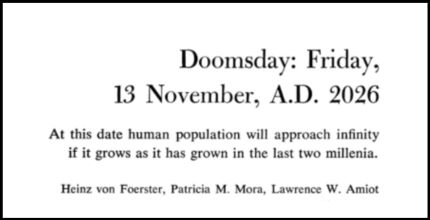
The article certainly created a stir and was cited often in the following decades. But demographers pointed out flaws in the calculations, with some calling it “ridiculous”.
It may or may not have been a coincidence that von Foerster started his working life as a magician … and November 13 just happened to be his birthday. And did we mention it was Friday the 13th?
As it turns out, the global population growth began slowing after the early 1990s. Today, as the predicted Doomsday rapidly approaches, it sits around 8.2 million – far short of infinity.
“Unless there are billions of secret pregnancies out there, you shouldn’t be all that concerned,” concluded an article last month on popular-science website IFLScience.
Phew.
Stay informed, daily
Nonetheless, while we may not need to worry about being “squeezed to death”, society’s obsession with the so-called Doomsday is possibly even greater now than it was 60 years ago thanks to threats such as climate change and artificial intelligence.
The Doomsday Clock, created by a group of scientists in 1947 to show how close we are to a human-induced Armageddon, this year moved closer to midnight than ever before
“Humanity has not made sufficient progress on the existential risks that endanger us all,” Alexandra Bell, president and CEO of the Bulletin of the Atomic Scientists, said when announcing in January that it had moved four seconds forward to 85 seconds to midnight.
“The Doomsday Clock is a tool for communicating how close we are to destroying the world with technologies of our own making. The risk we face from nuclear weapons, climate change and disruptive technologies are all growing.
“Every second counts, and we are running out of time.”
But before we do run out of time, a science hub in Vienna, Austria, has chosen the Doomsday date of November 13 to host a conference that will explore the actual state of the world’s population and potential consequences of demographic trends.
It is titled “the sense and nonsense of end-of-the-world predictions” – with many commentators today arguing that von Foerster’s predictions, seemingly designed to stir controversy and argument, had a little bit of both.
“I don’t think [von Foerster] was seriously trying to predict the future,” Joel Cohen, a mathematical population biologist at Rockefeller University, told Science this month.
“He was drawing attention to a pattern [of population growth] which I don’t think was sufficiently appreciated.”
Canadian researcher Alan MacEachern, writing for The Conversation, argued that the one-time magician blended stagecraft and science to highlight his argument in “an ordinary scientific article wrapped in an extraordinary title and conclusion”.
“To draw the world’s attention to a serious matter by way of absurdity – that’s a good trick.”
In their 1960 article, von Foerster and his fellow researchers noted that alongside things such as higher taxes for families with more than two children, space travel had been recently proposed as an alternative means of controlling population growth.
“It is only unfortunate that no re-entry can be given to these space-trotters,” they concluded.
Want to see more stories from InDaily Qld in your Google search results?
- Click here to set InDaily Qld as a preferred source.
- Tick the box next to "InDaily Qld". That's it.