Iran’s supreme leader hints at new era for Strait of Hormuz
Ayatollah Mojtaba Khamenei has declared his nation the ‘final victors’ and promised to punish the country’s attackers.
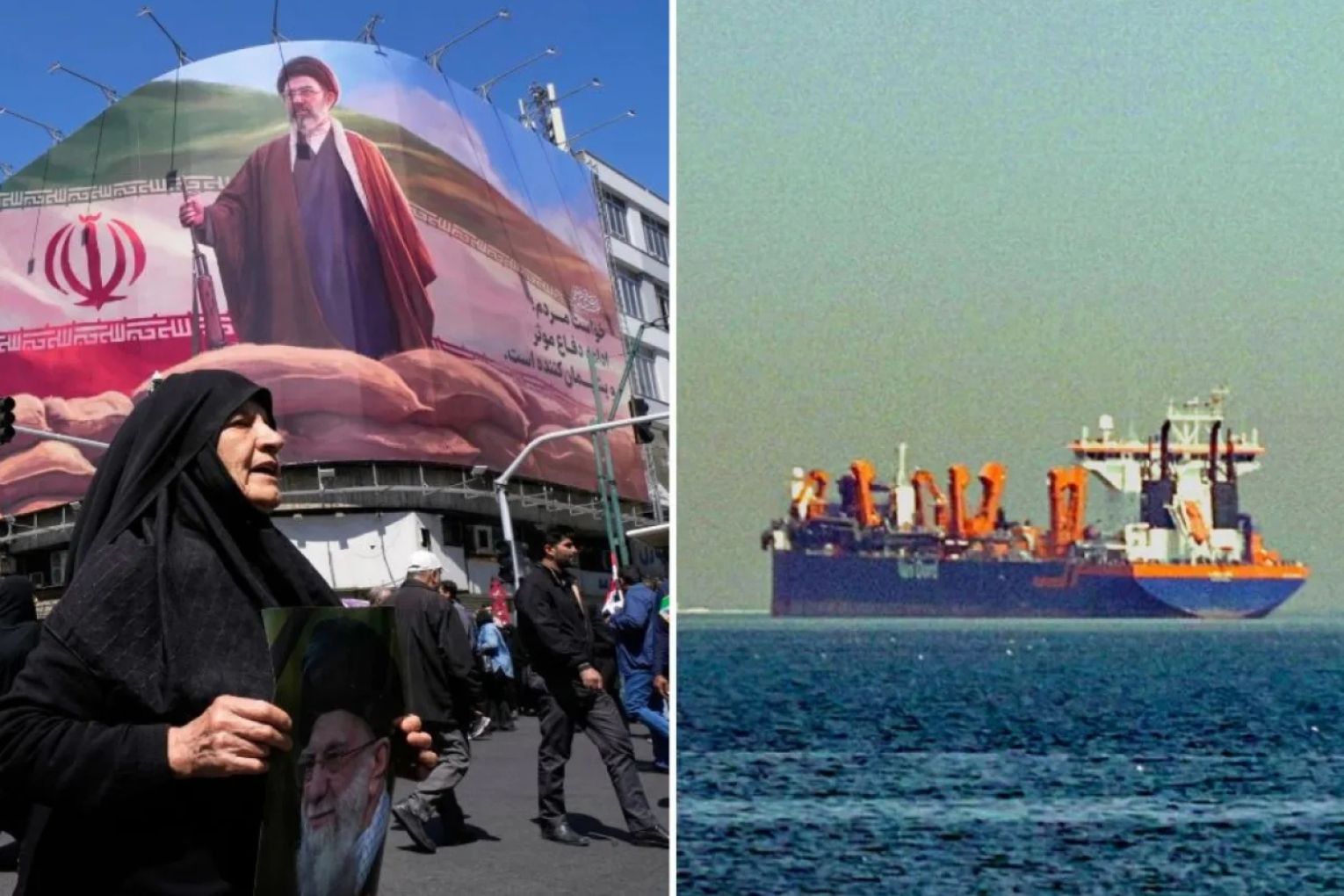
Iran’s elusive new supreme leader Ayatollah Mojtaba Khamenei has declared his nation the “final victors” while hinting at new plans for the Strait of Hormuz.
The leader has not been seen since taking over from his father Ali Khamenei, who was killed in an Israeli strike 40 days ago.
On Friday (AEST), a statement was read by a presenter on Iran state TV.
“Today, it is clear before everyone’s eyes, the dawn of the Islamic Republic’s emergence as a great power while the evil is facing the downhill slope of weakness,” said the statement.
The ayatollah vowed punishment against the “criminal aggressors who attacked our country”, saying Iran would “demand compensation for all damages, as well as the blood of the martyrs and the wounded”.
He also foreshadowed plans for the Strait of Hormuz, saying Iran would move towards a “new phase” or “new era”, however he did not elaborate with details.
Iran’s blockade of the strait has caused the worst disruption to global energy supplies in history.
But there has been no sign Iran is lifting its near-total blockade, despite reaching a ceasefire agreement with the US on Wednesday (AEST).
You might like


In the first 24 hours of the ceasefire, just a single oil products tanker and five dry bulk carriers sailed through a strait.
Typically it accommodated 140 ships a day before the war, accounting for about a fifth of the world’s oil and liquefied natural gas flows.
US President Donald Trump announced a ceasefire in the six-week-old Iran conflict on Wednesday, just hours before a deadline after which he threatened to destroy Iran’s civilisation.
However the ceasefire hit a major hurdle when Israel launched its worst strikes yet on Lebanon on Thursday (AEST), killing more than 300 people.
Israeli Prime Minister Benjamin Netanyahu on Friday (AEST) said he was seeking direct talks with Lebanon.
Netanyahu, whose government rebuffed a historic offer for direct talks with Lebanon last month, said in a statement that he had given instructions to start peace talks as soon as possible, which would also include disarming Iran-aligned militant group Hezbollah.
“In light of Lebanon’s repeated requests to open direct negotiations with Israel, I instructed the cabinet yesterday to start direct negotiations with Lebanon as soon as possible,” he said.
“The negotiations will focus on disarming Hezbollah and establishing peaceful relations between Israel and Lebanon.”
An hour before Netanyahu’s statement, Lebanese President Joseph Aoun said he was working on a diplomatic track on this matter that was starting to be seen “positively” by international actors.
A senior Lebanese official told Reuters that Lebanon had spent the last day pushing for a temporary ceasefire to allow for broader talks with Israel, describing the effort as a “separate track but the same model” as the US-Iran truce.
Stay informed, daily
The official said no date or location had been set yet but that Lebanon needed the US as a mediator and guarantor of any agreement.
Israel, which invaded Lebanon last month in parallel with the war on Iran to root out Hezbollah, says its actions there are not covered by the ceasefire.
The US has also said Lebanon is not covered by the truce but Iran and Pakistan, which acted as mediator, say it was explicitly part of the deal.
A host of countries including the United Kingdom and France said the truce should extend to Lebanon.
Iran’s parliament Speaker Mohammad Baqer Qalibaf, expected to head the Iranian delegation opposite US Vice President JD Vance, said on X that Lebanon and the rest of Iran’s “axis” of regional allies were inseparable parts of any ceasefire.
A Pakistani source said Pakistan was working on ceasefires for Lebanon as well as Yemen, where Israel has also hit Iran-aligned forces.
Israel kept up its bombing of Beirut’s southern suburbs and other parts of the country on Thursday, Lebanese media said.
It also expanded evacuation orders for areas on Beirut’s outskirts to areas near Beirut airport and several displacement shelters.
Hezbollah announced at least 20 military operations on Thursday, saying it had targeted Israeli vehicles on Lebanese territory as well as firing into northern Israel.
Lebanese officials declared a day of mourning after Wednesday’s attacks on heavily populated areas, which they described as a “massacre”.
Outside Beirut’s Rafik Hariri University Hospital, a steady stream of ambulances arrived throughout Thursday afternoon full of mangled bodies recovered from the sites of Israeli strikes the previous day.
“We’re picking up body parts for the most part. It’s very rare that we find entire bodies intact,” a rescue worker said.
US broadcaster NBC News reported, citing a senior US official, that Trump called on Netanyahu on Wednesday to scale back Israeli attacks in Lebanon.
The website Axios, also citing US officials, reported that US special envoy Steve Witkoff made a similar request in a separate conversation with Netanyahu.
-with AAP/DPA
Want to see more stories from InDaily Qld in your Google search results?
- Click here to set InDaily Qld as a preferred source.
- Tick the box next to "InDaily Qld". That's it.