‘Not Jesus Christ’: Joyce grilled on super raid plan
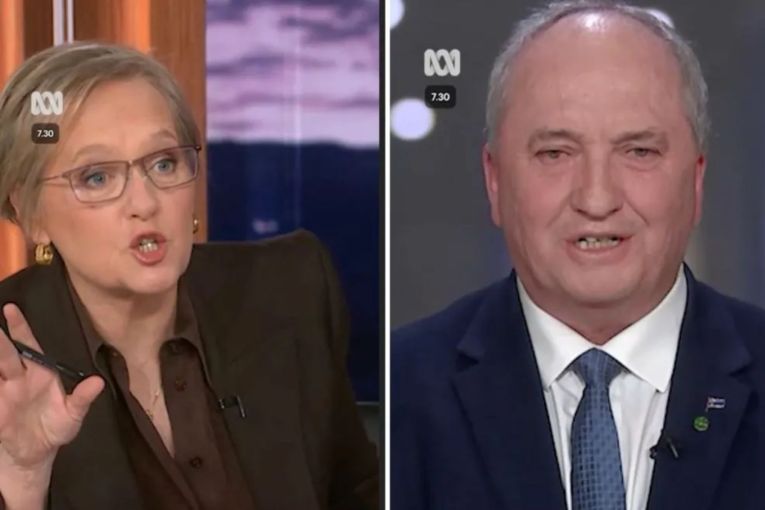
Barnaby Joyce has had an on-air meltdown, including declaring he is “not Jesus Christ” after struggling to answer basic questions about One Nation’s super plan.
Source: ABC
One Nation’s would-be treasurer, Barnaby Joyce, has been unable to explain how much superannuation Australians would lose from their retirement under the party’s “economically disastrous” policy to allow early access.
About seven million Australians would be able to use a quarter of their super to meet housing costs under the proposal economists warn would worsen inflation.
Joyce, One Nation’s finance spokesman, had another television meltdown moment when he was grilled on the policy on ABC’s 7.30 on Monday.
Host Sarah Ferguson tried to get an answer from Joyce about how much would be drained from people’s retirement if they took advantage of the policy.
But an exasperated Joyce insisted the calculations Ferguson wanted were too detailed and he was “not Jesus Christ”.
“Have you put together figures on the loss to people’s retirement savings over time if they were to use this facility?” Ferguson said.
Joyce: “Well, once again, that’s — how long is a piece of string Sarah? Tell me which person you’re referring to.”
Ferguson: “I’ll give you an example and you tell me how much it would cost them in foregone retirement income. These are figures from bank economists.”
You might like
Joyce interjected sarcastically: “As you know you delivered them [the details] to me before the interview. Well, here we go folks, I’ll try to answer something that we’ll need an annuity table and will also need a sort of lineal regression, but I’ll do it for you, straight down the barrel.”
Ferguson insisted Joyce should be across the detail: “Barnaby Joyce, if I may, obviously this is a policy that your party has come up with, so we would expect you as the treasury spokesman for that party to be across it, just try it.”
But Joyce interjected that he was “the treasury spokesman, not Jesus Christ”.
“I mean you actually have to give me the details of these things if you’re going to put them forward to me,” he said.
Ferguson said a “30-year-old earning the average wage of $108,000 using the scheme would be $91,000 foregone, a 40-year-old $51,000, a 50-year-old, they would be $27,000 worse off”.
Joyce: “Well folks, how on Earth, how does … well, this is ridiculous, this is like saying, ‘Look, now I’m going to give you an incredibly complex question’. Well Sarah I’m happy to come back to you tomorrow.”
Ferguson: “Good let’s do that.”
Joyce: “As long as you’re prepared to pay my accountancy fees, we can do this regression analysis, I can go through the actuarial tables … what is your average return that you’re presupposing the super is going to get?”
One Nation’s policy would allow workers to divert a quarter of their super contributions towards rent or a mortgage for up to three years.
Employers would still have to pay 12 per cent superannuation, but super funds would then pay 3 per cent to people participating.
Stay informed, daily
But economists said the scheme, which would give a median wage earner an extra $44 a week, would pump up house prices and inflation, making the Reserve Bank’s job harder.
“If take-up is anything like the 2020 early release scheme, billions a year would be pumped into household spending while inflation is 3.5 per cent, and the RBA has a tightening bias,” Swinburne economist Jason Tian said.
“That would keep rates higher for longer and hurt the very mortgage holders it targets.”
Independent economist Saul Eslake said more than 60 years of evidence showed allowing people to spend more money on housing than they otherwise would — such as shared equity schemes and first-home buyer grants — led to more expensive homes and fewer people owning them.
Association of Superannuation Funds of Australia chief executive Mary Delahunty said it would be “economically disastrous”.
“When you pour more money into a high-inflation economy, it makes everything more expensive,” she said.
“This proposal would not alleviate the cost of living; it would drive the cost of living higher.”
Modelling by the Super Members Council showed a median full-time worker who withdrew three per cent of contributions for three years at age 25 would be $25,000 worse off by the time they retired.
Lower retirement balances would mean billions of dollars extra in aged pension bills, which would have to be funded by higher taxes or more spending cuts.
“There are smarter and better ways to help Australians struggling with housing costs – such as talking to your bank about relief options — and none of them involve telling Australians to raid their super and their futures,” council chief executive Misha Schubert said.
Superannuation can be accessed before retirement for compassionate reasons, such as for medical treatment, funeral costs or preventing a house being foreclosed.
Tax office figures show 67,900 early super releases were approved in 2024/25, amounting to just over $1.4 billion.
Treasurer Jim Chalmers said the policy would make workers poorer as a result.
“It will cut your super. This means less money and less economic security for millions of Australian workers. This will end superannuation as we know it,” he said in Canberra.
“This is exactly why One Nation poses an unacceptable and dangerous risk to Australian workers.”
Deputy Opposition Leader Jane Hume said there were unanswered questions surrounding One Nation’s proposal but agreed the best indicator of economic security in retirement was owning your own home.
-with AAP
Want to see more stories from InDaily Qld in your Google search results?
- Click here to set InDaily Qld as a preferred source.
- Tick the box next to "InDaily Qld". That's it.