Finding our identity: Art maps the contradictions at the heart of a nation
Veteran artist Sebastian Di Mauro plays with Australian history in his latest exhibition at Onespace in Brisbane.
An exhibition that explores ideas of immigration and colonialism and our national identity could not be timelier. And it just goes to show that while Brisbane artist Sebastian Di Mauro may spend half his year in the US where he lives with his partner, he is right on the money when it comes to issues that matter.
His commentary is delivered in a visual language that attracts the attention without making us baulk. There is no lecturing or hectoring in his latest exhibition at Onespace. The show is called Unsettled Ground for a particularly good reason – because that’s kind of what we are standing on.
Take a work such as Stitched, which is representative of this show. As Dr Christian Rizzali points out in a catalogue essay, “Di Mauro has taken a piece of kitschy Australiana – an image of gum trees in a quintessentially Australian landscape, copied from a tapestry the artist found in a secondhand store – and has inserted an English garden folly in the scene”. Garden follies (in this case a neoclassical structure) are an ornamental presence in English gardens, although in this work the folly is juxtaposed with gum trees.
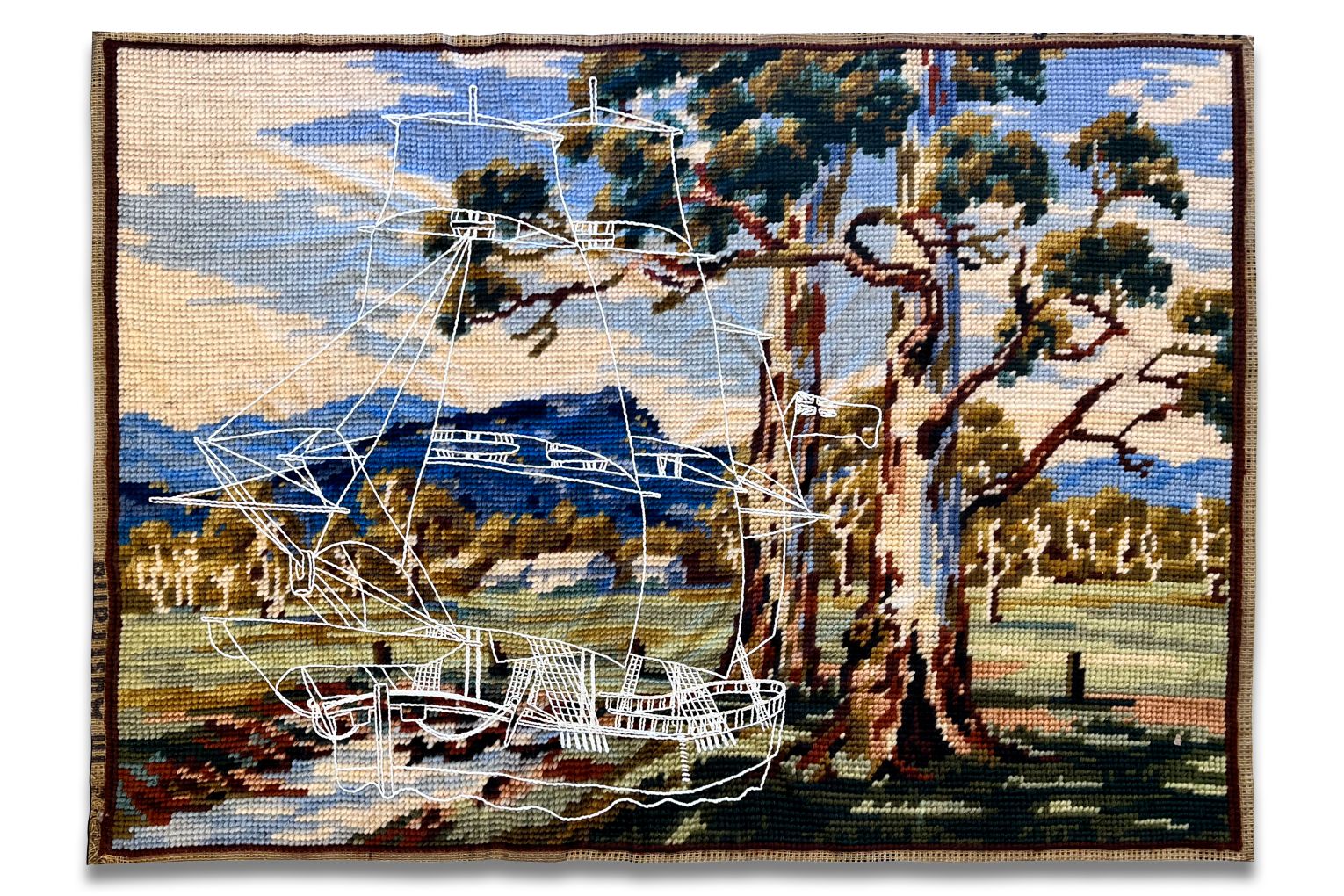
In Ghost Ship the tapestry background (a digital print of the found tapestry work he uses) is an Australian landscape, with gum trees in the foreground overlaid with a stitched outline of a ship – HMB Endeavour, of course.
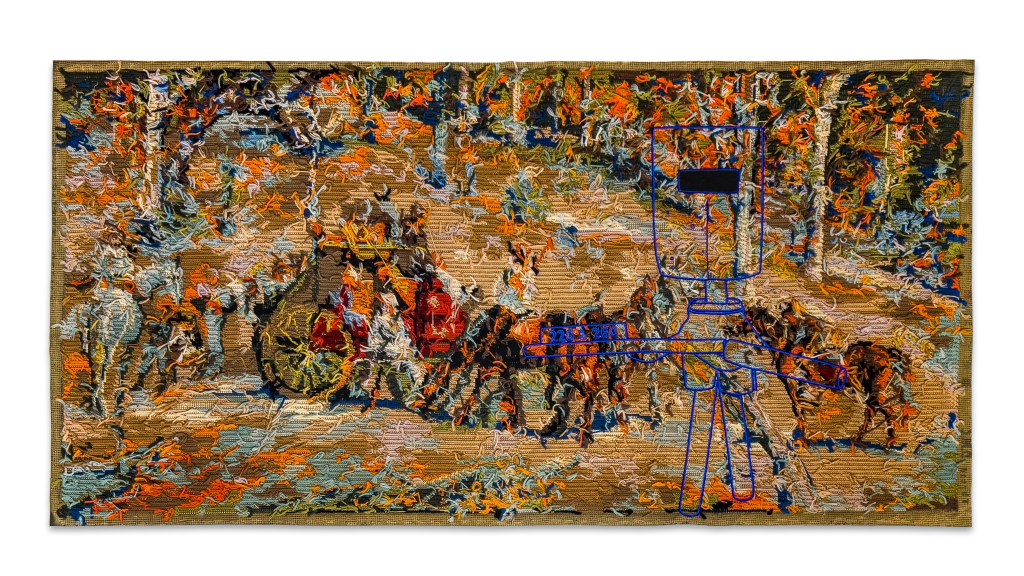
In Bolters (another tapestry) we see a colonial stagecoach scene, and this one riffs on a famous Australian painting – Bailed Up by Tom Roberts.
You might like
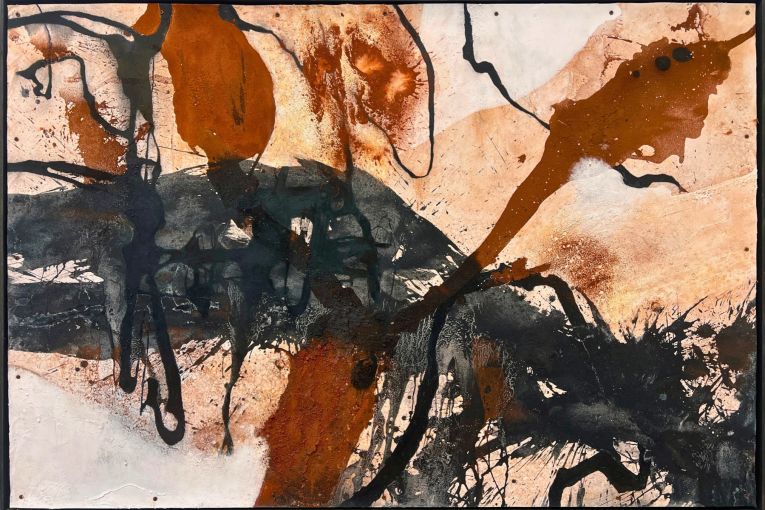
These tapestry-inspired works are large and all reference colonial history. The artist does want to point out that the British were immigrants, too – this at a time when immigration is a festering issue in the nation’s psyche.
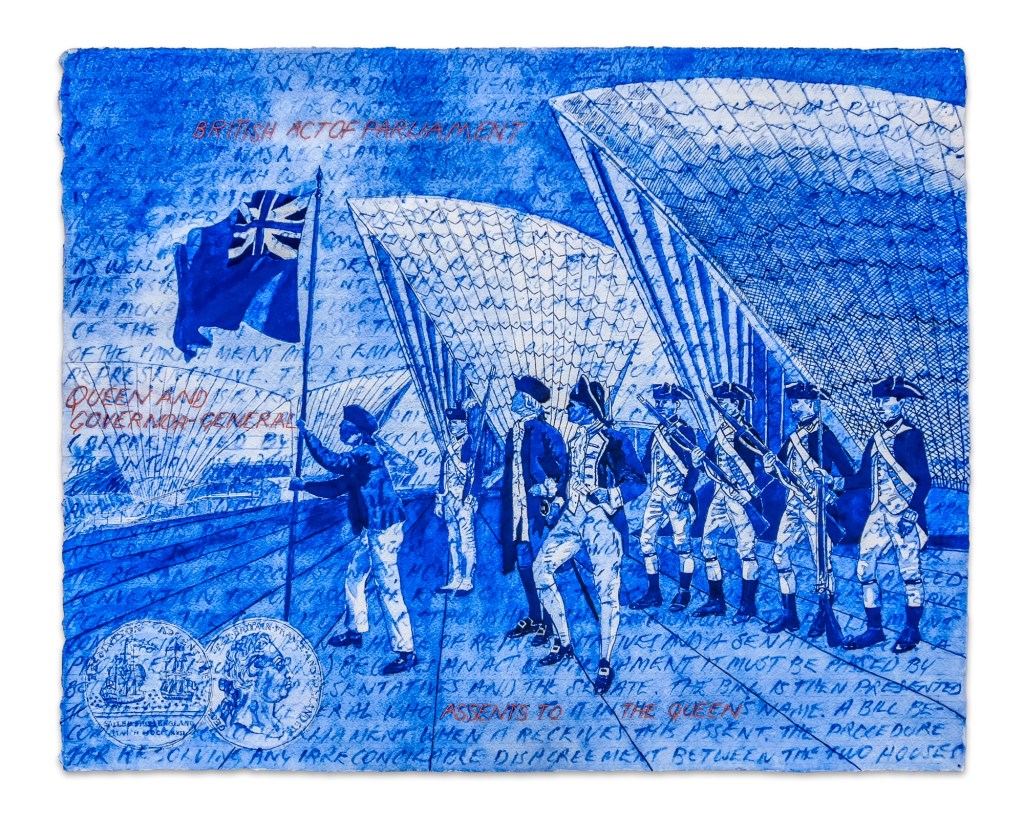
Dr Rizzali writes that “Di Mauro calls to attention this deep hypocrisy, visualising the discordant presence of British culture and law on Australian land”.
“Through a wide array of techniques, and a healthy dose of humour, Di Mauro demonstrates the shocking absurdity of our enduring ties to Mother England,” Dr Rizzali says.
The use of embroidery highlights particular features or passages and gives some works a more textile quality.
There is the embroidered HMB Endeavour and various other stitched motifs including a version of a kangaroo, referencing an early work by George Stubbs called The Kongouro from New Holland, dating from 1772. Although, as the catalogue essay points out, “Stubbs Kongouro looks more like a Jurassic hare than a real kangaroo”.
Subscribe for updates
These larger works sit alongside a suite of watercolours overlaid with passages of text from the Australian constitution. Although held sacrosanct by some, Di Mauro believes that the constitution at times reflects “the worst elements of an age long past”. So, Di Mauro interrogates the contradictions at the heart of a nation that calls itself modern yet remains bound to the symbols and systems of empire.
Despite Australia now being home to hundreds of nationalities, creating a pluralistic culture, our symbolic head of state remains a monarch on the other side of the world. Go figure. The ghosts of empire haunt the works in a witty, irreverent and, at times, nostalgic fashion. As I said, his work does not lecture or hector, but it does pose truly relevant questions.
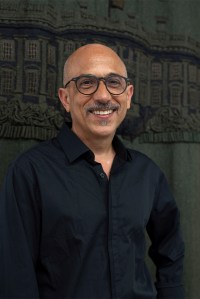
Di Mauro, 70, is one of our most interesting artists with more than 40 solo exhibitions under his belt. The Innisfail-born artist has a constant presence in Brisbane, thanks to numerous public art works such as Drift, at 33 Charlotte Street,Brisbane. He is an adjunct associate professor at Queensland College of Art, Griffith University.
Also, showing at Onespace is the exhibition Tales from the In-Between by Zoe Porter. This exhibition spans photography, video and an artist book. The catalogue suggests that Porter “converses with a lineage of feminist surrealism that dissolves binaries such as human and animal, reason and instinct, domestic and wild”.
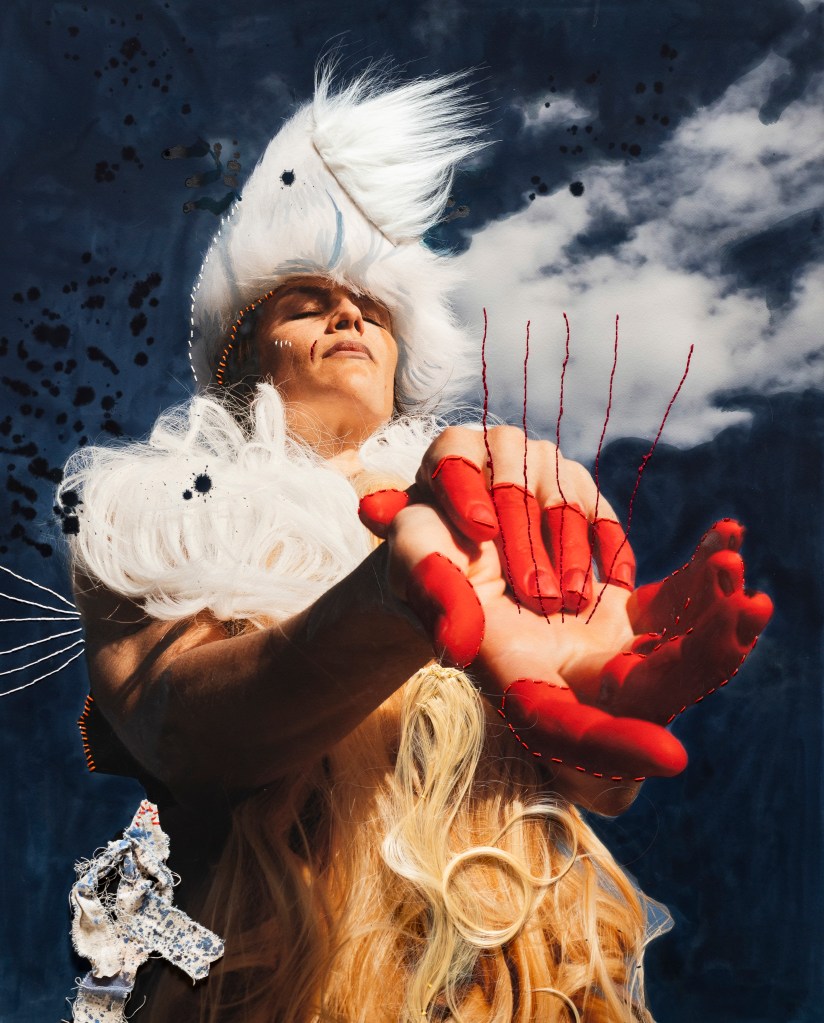
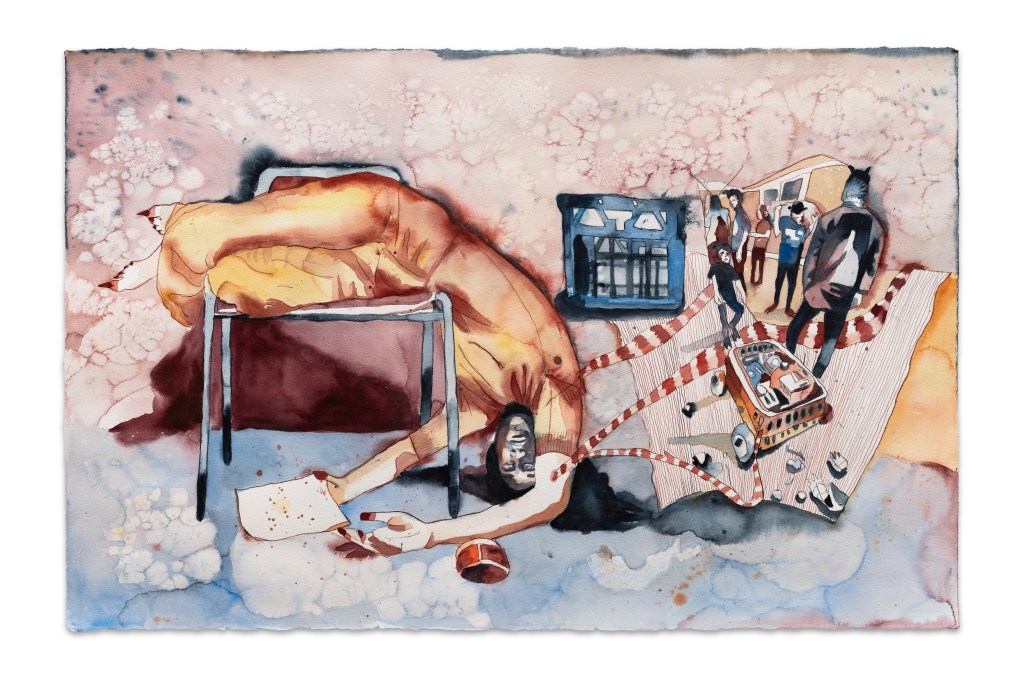
Her works are intriguing and sit comfortably alongside Sebastian Di Mauro’s. These figurative works, photos embellished and draped in fur, tassels of fabric and featuring conical white hats, are as striking as they are mystifying.
Porter collaborated with photographer Billie-Wilson Coffey on this suite of works featuring acrobat and circus performer Bridie Hooper, who some of us know through her work with Circa. This sets her in an entirely new context in artworks that, according to the catalogue, ask the viewer “to unsettle what they think they know and be seduced, if only for a sweet moment”.
Sebastian Di Mauro: Unsettled Ground and Zoe Porter: Tales from the In-Between continue at Onespace, South Brisbane, until February 28.
Want to see more stories from InDaily Qld in your Google search results?
- Click here to set InDaily Qld as a preferred source.
- Tick the box next to "InDaily Qld". That's it.
Free to share
This article may be shared online or in print under a Creative Commons licence