Warm embrace for silent histories’ abrasive past
Mandy Quadrio’s sculptures tell stories with echoes of trauma in order to reclaim forgotten histories.
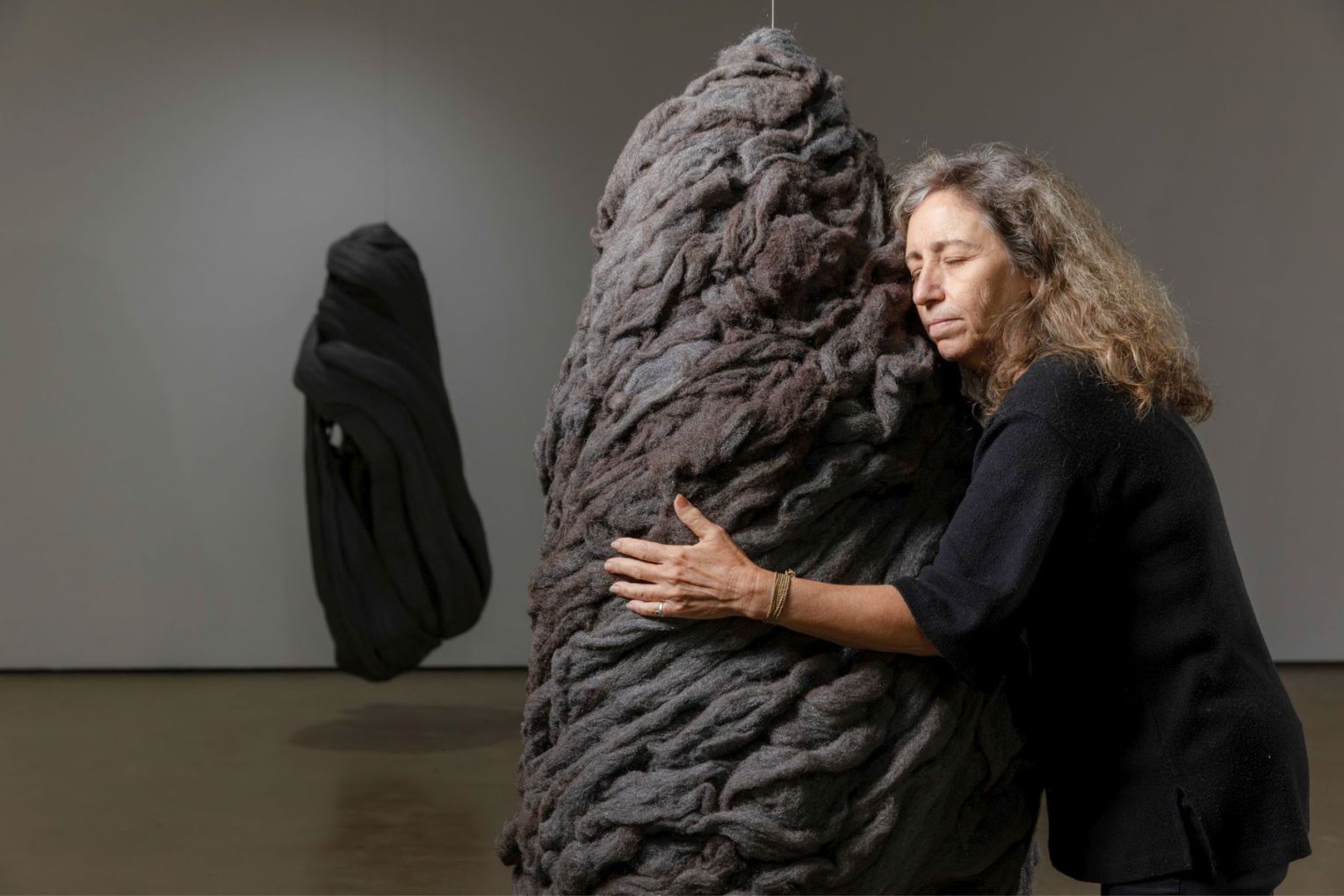
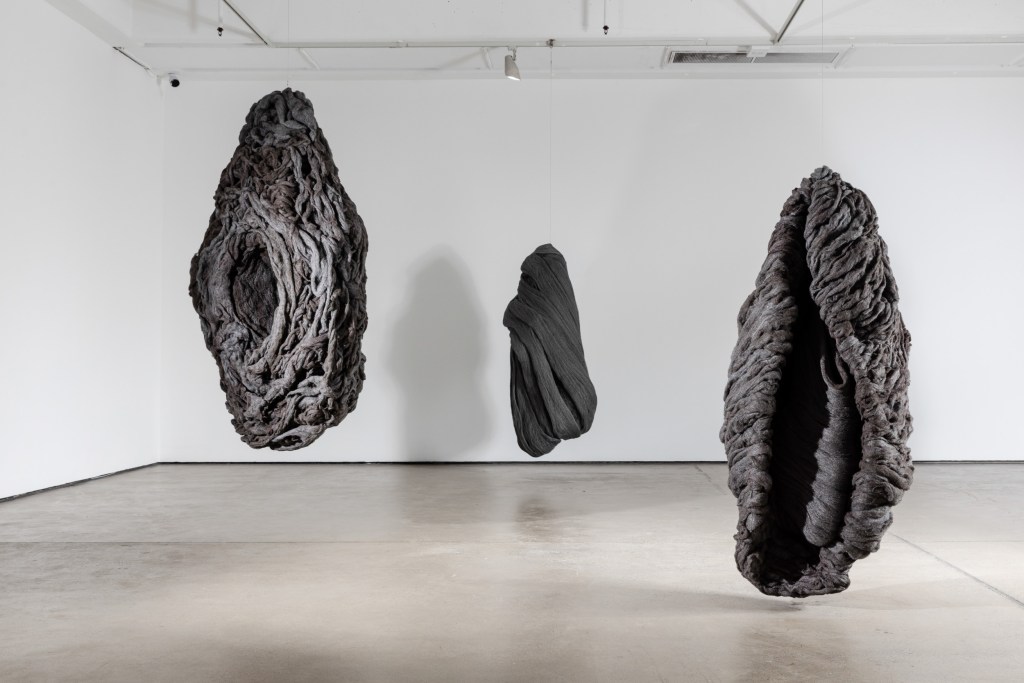
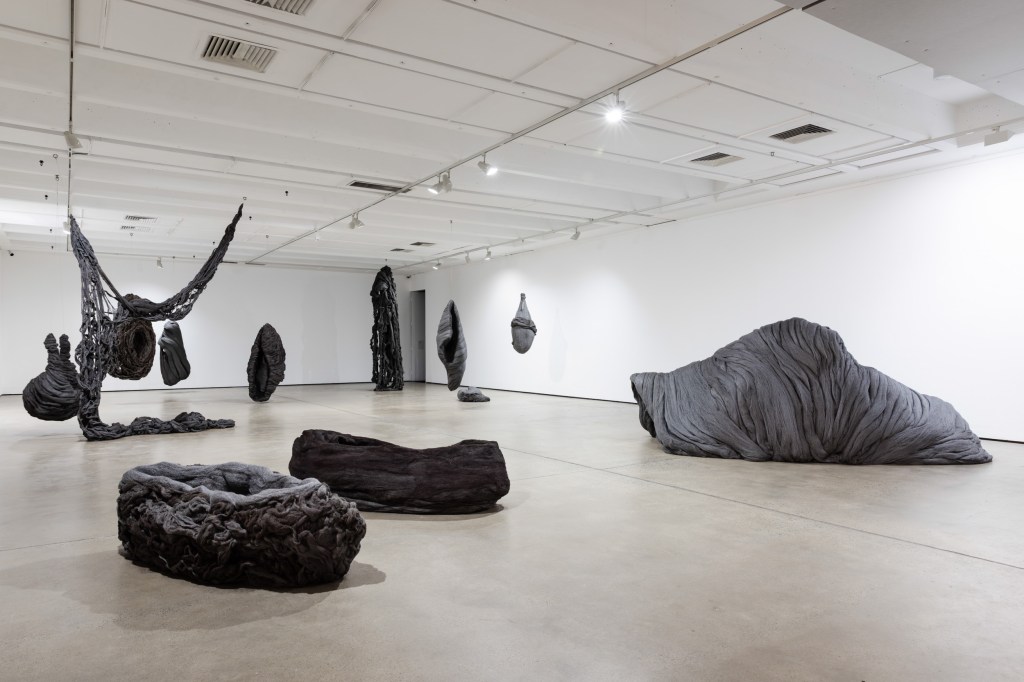
In a large, white-painted room, low ambient voices revolve around a sparse forest of sculptures, some slumped on the floor as though fallen; others hanging from the ceiling, gently spinning. Another, knotted and looped in a rainforest-like tangle, joins ceiling to floor and drapes like a body on the floor.
Each of these works is made from steel wool, some taking on the quality of spun silk or finely brushed hair in their cocooning shapes, and others more like dreadlocks, densely knotted or twisted. In these shapes are a myriad of organic forms, emerging to resemble rosettes, lips, faces, womb-like and vulval forms, and tangles of sinew, each with openings into the darkness of their internal spaces.
Mandy Quadrio’s exhibition Kukunna Wurraweena, now on at the Institute of Modern Art in Fortitude Valley, is titled in Lutruwita/Tasmanian language, which (loosely) means “holding the weight of silence”.
Her life history, and that of her Trawlwoolway Aboriginal antecedents, is both subject and context for this work, which uses steel wool’s harsh material realities to extend the debate about the impact of colonisation on Australia’s First Nations’ peoples.
At a discussion following the exhibition’s opening, Quadrio says she has been “working with steel wool ever since my undergraduate years at university”.
“I started initially with a piece of steel wool from the kitchen sink, and now it’s grown into industrial quantities,” she explains. “I work with it very carefully, because it’s a hostile material, and steel fibres can slice your flesh. However, I love how the work manifests in sensuous shapes and forms. It’s like drawing in space in the way that the material lends itself to beautiful configurations. It looks so soft and smooth, as well as being so gnarly and entangled.
You might like
“I’m one of few people who work with this abrasive material. It speaks to my history, this notion of erasure, cleaning away, scrubbing out, coming from a Tasmanian Aboriginal heritage. Our people have suffered under a brutal colonisation, and so this idea of erasure is particularly relevant.”
The low voices heard is from the soundtrack of a film running in an adjacent room. Tugrannah: A black pause at the beginning is Quadrio’s first moving-image work. It uses a recording of Quadrio’s sister (now deceased) singing, with Quadrio joining the lament, while images of burning steel wool float over a black background, a continuum that explodes, flaring before fading away to emerge again. These bursts of light into the darkness evoke grief, the cosmos or a conflagration of cells that speak to the cyclical nature of life and death, and the crucial importance of fire.
‘My works are completely embedded with stories, events, family, people, experiences, memories and vastness’
Moving around the larger room of works, looking into forms that exude trauma in their violently wrested and tied hanging shapes, but also nurture, with each featuring caves and cocoons that invite audiences in. There is a strong sense of personal narrative that infuses the historical research she brings to this work. In this forest of sculptures, many are veiled, hooded, protective – both in form and harsh materials.
“My works are completely embedded with stories, events, family, people, experiences, memories and vastness – 65,000 years of history that I’m still trying to come to terms with.”
Subscribe for updates
Then there is her personal familial disruption.
“My mother vanished when I was an infant, and she’s never been found, and there has never been any closure. I have this personal notion of erasure as well as erasure that speaks collectively to my people. So, the material is pertinent to the stories that I’m bringing forward.”
Since her graduation from Queensland College of Art in 2017 (and a doctorate in 2021), Quadrio has explored an innovative sculptural practice, working with natural organic materials in addition to steel wool, with an interest in sustainability notable in the ephemeral qualities of her work. While conceptually they seek to disrupt the hierarchies that have impacted her family and culture, physically the steel wool will rust. Her other materials – bull kelp, animal skins and natural fibres – will also deteriorate.
This emphasises the cyclic qualities embedded in her ideas.
“I like how the work isn’t static. It changes. The evolution of the material is unpredictable, unstable. Sometimes that’s frustrating, but I must surrender myself to the fact that the material has a mind of its own.”
Kukunna Wurraweena is the largest and most significant of Quadrio’s exhibitions to date. This body of work holds its silences and histories, extended with voices lifting and carrying individual and cultural narratives, created in materials at once domestic and industrial. In its evocative presentation, Quadrio powerfully captures the personal and the political in three dimensions.
Mandy Quadrio: Kukunna Wurraweena exhibition, a Commissioners Circle Project, continues at the Institute of Modern Art, Fortitude Valley, until June 28.
Want to see more stories from InDaily Qld in your Google search results?
- Click here to set InDaily Qld as a preferred source.
- Tick the box next to "InDaily Qld". That's it.
Free to share
This article may be shared online or in print under a Creative Commons licence