Ask the Expert: How much retirement savings do you really need? It’s complicated
This week, our superannuation expert answers questions about retirement savings and ETF investments.

Question 1
What is a reasonable amount to have in retirement savings?
That is a very broad question. It depends on what you are saving for – a holiday, car, emergency fund?
Often this question is asked in terms savings for retirement.
There are two groups that do provide some high-level benchmarks on what super is required for retirement.
Firstly ASFA (Association of Super Funds of Australia) provides the below estimates. It assumes a retirement age of 67.
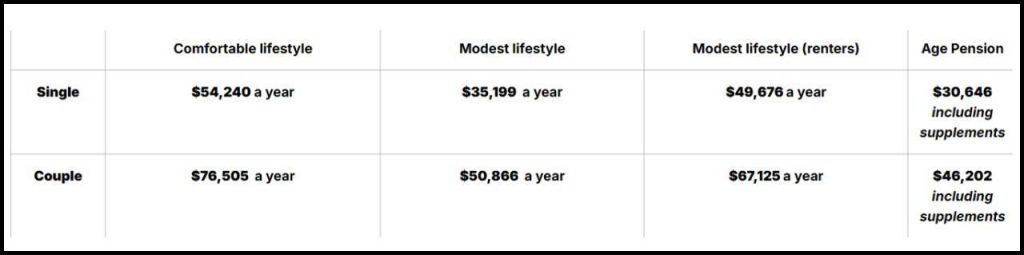
Source: ASFA
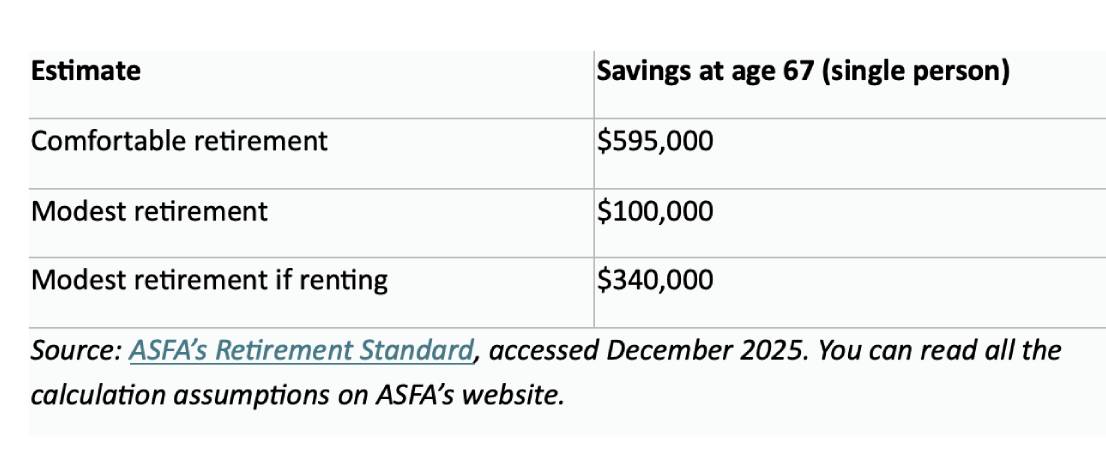
To achieve the above, ASFA suggests what your super balance at age 67 is required, as per the below table:
You might like
Super Consumers Australia assumes a retirement age of 65 and provides the following estimates:
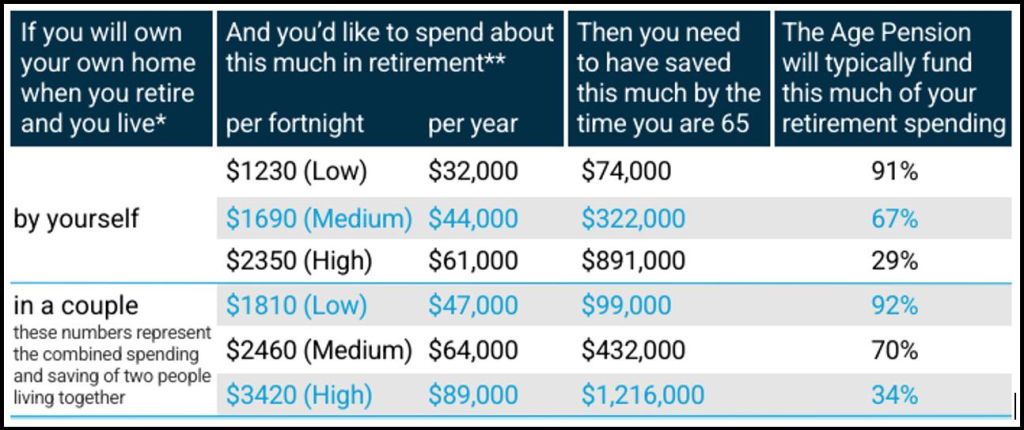
Source: Super Consumers Australia
Its great that these organisations provide benchmarks. However, everyone is different and the best approach is to set your own goals and have your own number.
When you set a specific, realistic and personal target, it’s motivating and you are more likely to achieve it.
The government’s Moneysmart website has a good range of calculators to help you set savings goals, superannuation projections and retirement calculations.
Try these out, along with your super fund’s calculators, to help you set realistic goals.
Question 2
What exactly is it that ETFs invest in? Is it the actual investments themselves, or is it a synthetic portfolio built of derivatives?
Stay informed, daily
Exchange Traded Funds are becoming an increasing popular investment vehicle. That is because they are fairly cheap and offer good diversification.
ETFs are funds that are listed on a stock exchange, such as the Australian Securities Exchange. You can purchase ETFs in the same way as you purchase shares.
Most ETFs are aimed at simply tracking a market index, such as the ASX 200 or Dow Jones; there are a huge range of indices that you can choose from. There are also active ETFs that try to outperform a given market.
Coming directly to your question, how do they do this?
There are two main approaches. The first way is the ETF buys and holds the actual shares (or bonds etc) that make up the index. This can be done by buying every share in the index at the exact percentage it makes up in the index.
For example, using the table below, if the ETF wanted to track the ASX 200, it would buy 7.27 per cent of the portfolio in Commonwealth Bank shares, 6.15 per cent of the portfolio in BHP shares etc.
Sometimes the ETF invests in only a sample selection of the largest or representative shares, a practice that is common for large or complex indices. For example, companies that are between 190 to 200 would make up such a small percentage of the ASX200 it may not be worth holding them.
Finally, yes, some ETFs use derivatives such as swaps (synthetic replication) to mirror the indice’s performance, aiming to match the returns before fees.
You would need to check with a particular ETF provider to see which of the above approaches it uses.
Craig Sankey is a licensed financial adviser and head of Technical Services and Advice Enablement at Industry Fund Services.
Disclaimer: The responses provided are general in nature, and while they are prompted by the questions asked, they have been prepared without taking into consideration all your objectives, financial situation or needs.
Before relying on any of the information, please ensure that you consider the appropriateness of the information for your objectives, financial situation or needs. To the extent that it is permitted by law, no responsibility for errors or omissions is accepted by IFS and its representatives.
Want to see more stories from InDaily Qld in your Google search results?
- Click here to set InDaily Qld as a preferred source.
- Tick the box next to "InDaily Qld". That's it.