Brisbane Stadium details revealed amid heritage debate
The Brisbane Stadium design team have locked in critical features of the venue despite ongoing applications to protect the Park as a heritage-listed space.
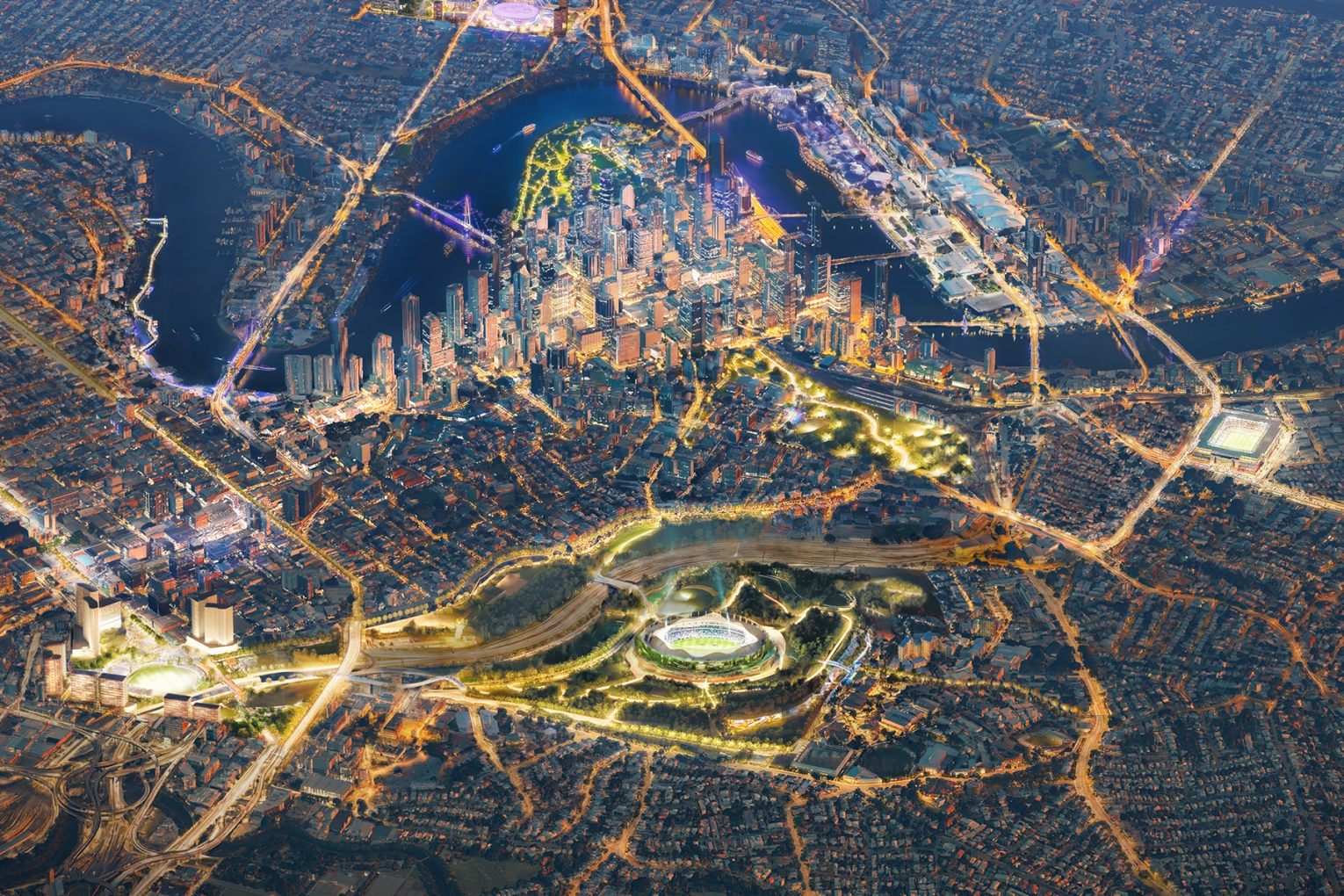
The Brisbane Stadium design team has finalised design details such as size, field orientation and the stadium’s location within Victoria Park, just over two months after its appointment.
But an advocacy group that has been campaigning for the 150-year-old park’s protection since 2020 claims a start date is a public relations stunt to give the false impression of efficiency.
Plans show the Brisbane Stadium will be equivalent in size to the Melbourne Cricket Ground, with a proposed field of play supported by AFL, Cricket Australia, concert promoters and Brisbane 2032.
The field size was decided after comparison to the Gabba, Perth’s Optus Stadium, the MCG and Marvel Stadium in Melbourne.
It has also been decided that the stadium will be configured east to west, after analysis of sun, wind and legacy operational needs for AFL and cricket.
The location of the stadium has been selected near Gilchrist Avenue to maximise access to public transport, putting the stadium between two hills in a naturally occurring amphitheatre.
You might like
Federal Minister for Infrastructure, Transport, Regional Development and Local Government Catherine King says these venues will deliver real benefits for Brisbane for years to come.
“These landmark venues and their surrounding infrastructure are taking shape fast and will be worthy homes and major drawcards for the state’s sporting and cultural events long after the Brisbane 2032 Olympic and Paralympic Games,” King said.
Deputy Premier and Minister for State Development, Infrastructure and Planning Jarrod Bleijie said exactly 12 months since the Crisafulli Government unveiled its 2032 Delivery Plan, the government had already achieved significant momentum.
“To get the Games back on track, we’ve been working calmly and methodically, but also quickly to lock in details and appointments for our 2032 and beyond venues, which will deliver generational and city-shaping infrastructure and economic benefits,” Bleijie said.
Early preparatory works will begin on June 1, when the land tenure is transferred to the Games Independent Infrastructure and Coordination Authority (GIICA).
The Brisbane Stadium will be funded by the $7.1 billion Games Venues Infrastructure Program, jointly funded by the state and federal governments, and delivered by GIICA.
Stay informed, daily
Meanwhile, Save Victoria Park, an advocacy group that has been campaigning for the 150-year-old park’s protection since 2020, claims the June 1 start date is a public relations stunt to give the false impression of efficiency.
Save Victoria Park’s Rosemary O’Hagan said, “At this stage, there is no substantial design for the stadium. Saying it will be built ‘down near Gilchrist Avenue’ is a meaningless statement.”
She adds that geotechnical study results and project validation reports confirming the venue’s viability had not yet been released, nor have civil works contractors been confirmed.
O’Hagan also said the mandatory community consultation promised as part of the funding agreement with the Commonwealth had not been carried out.
“The community has a right to know, but the government and its Games Infrastructure Authority are unable to disclose answers to these very basic questions,” O’Hagan said.
The 63,000-seat stadium will reportedly cost $3.785 billion and impact nearly two-thirds of the 60-hectare park.
Gaja Kerry Charlton, a Yagara Magandjin Aboriginal Corporation spokesperson, is trying to protect Victoria Park under the Federal Aboriginal and Torres Strait Island Heritage Protection Act.
“We are pursuing every legal avenue possible to protect our cultural heritage and we will continue to follow the federal process,” Charlton says.
“We are pro-Olympics, but we are anti-stadium in Barrambin. This project shows a lack of care for Aboriginal cultural heritage.”
“They are talking about something that will cost many billions of dollars to build, and people are already struggling with the daily costs of living.”
In early February, last-minute Olympic bill amendments were put through Queensland Parliament, converting Victoria Park from trust land to freehold land from June 1.
Freehold land means the government is free to sell the land to the private sector, though the park has been ‘trust’ land for the last 150 years, meaning it can be leased but not sold.
Want to see more stories from InDaily Qld in your Google search results?
- Click here to set InDaily Qld as a preferred source.
- Tick the box next to "InDaily Qld". That's it.