Australia battles worst diphtheria outbreak in decades
Doctors have raised the alarm over one of Australia’s worst outbreaks of diphtheria, which has crossed state borders and may have claimed a life.

Doctors have raised the alarm over one of Australia’s worst outbreaks of diphtheria, which has crossed state borders and may have claimed a life.
So far 223 cases have been reported since March in four states — 133 in the Northern Territory, 79 in Western Australia, six in South Australia, and up to five in Queensland.
That is compared to fewer than 40 cases across the country in 2025.
Federal Health Minister Mark Butler described it as the biggest diphtheria outbreak in Australia for decades.
“There’s no question this is serious,” he told ABC Radio on Tuesday.
Diphtheria is a potentially fatal and rare respiratory disease. It was once a cause of childhood death globally before vaccination started in the 1930s.
It’s feared a drop in childhood vaccinations may have allowed the disease to re-emerge.
Royal Australian College of General Practitioners vice-president Dr Ramya Raman urged doctors to remain vigilant as the infection crossed borders.
You might like

“It’s concerning that we’re seeing these cases now in Australia with this significant and quite unusual resurgence of the diphtheria cases,” she told newsGP.
“Diphtheria is something many Australians thought belonged to another era of medicine, but the reality is that vaccine-preventable diseases can return, particularly when continuity and immunisation gaps emerge.”
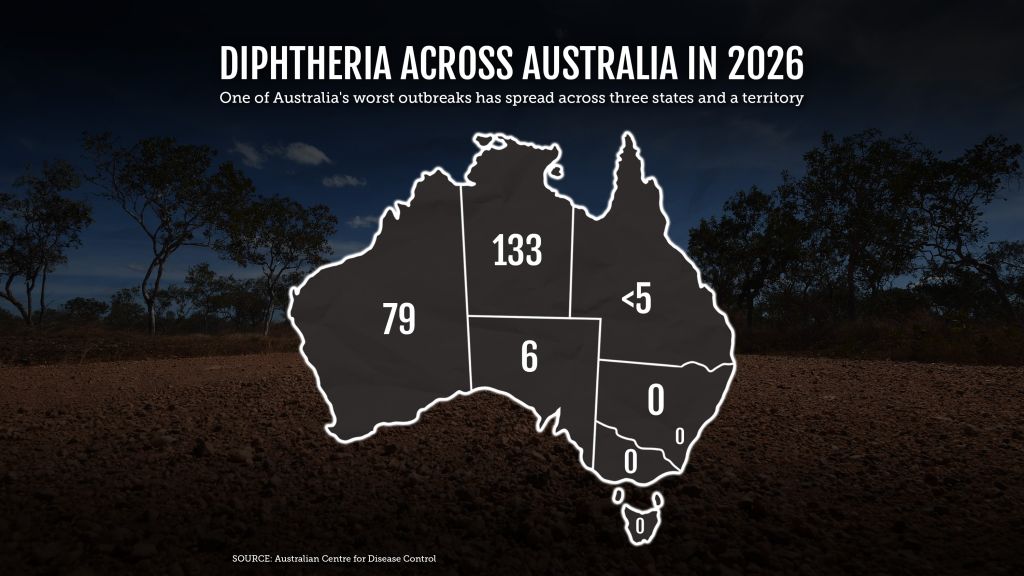
Diphtheria cases across Australian states and territories in 2026. Photo: AAP
Diphtheria can easily spread person to person through inhalation of respiratory droplets when an infected person coughs or sneezes.
Respiratory diphtheria symptoms can include a sore throat, mild fever, loss of appetite and in severe cases, trouble breathing. It can be fatal in some cases if untreated.
The less harmful strain of the disease is cutaneous diphtheria, spread by direct skin contact on lesions of infected people, with symptoms including sores or ulcers and slow-healing wounds.
Almost all the cases have involved Indigenous Australians, prompting health authorities to work with Aboriginal agencies to try to curb the outbreak, including provision of vaccines.
The National Notifiable Disease Surveillance System reports 133 notifications of the disease in the NT since the outbreak began in March.
It has since spread to Western Australia where 79 cases have been reported plus another six in South Australia and up to five in Queensland.
NT health authorities are also awaiting results from an autopsy about a possible diphtheria-related death in a remote territory community.
Stay informed, daily
Immunisation expert Milena Dalton, from Melbourne’s Burnet Institute, said the response to the outbreak needed to be in partnership with Aboriginal community-controlled health services and local leaders.
The outbreak required governments to support rapid vaccination, booster delivery, testing, treatment and contact tracing, she said.
“We do have the tools to stop it spreading further so we really need to ensure that those tools reach the communities that need them most,” Dalton said.
NT Health said it was working with community organisations on a territory-wide vaccination program, focusing on vulnerable people and at-risk areas.
“Vaccination remains the most important measure for preventing, protecting and reducing transmission,” it said.
Vaccination is free under a national program for children aged six weeks to two months, four months, six months, 18 months, four years and 12 years.
Pregnant women from 20 weeks are also eligible and adults are encouraged to get a booster vaccine every 10 years.
Ebola deaths rise
In Africa, the World Health Organisation has expressed deep concern about the spread of ebola after 131 deaths in eastern Democratic Republic of Congo.
WHO director-general Tedros Adhanom Ghebreyesus declared the outbreak of the rare Bundibugyo strain a global public health emergency on Sunday (AEST), the first time a WHO chief has done so before convening an emergency committee.
The outbreak has alarmed experts because it was able to spread for weeks undetected across a densely populated area ravaged by widespread armed violence.
“I’m deeply concerned about the scale and speed of the epidemic,” Tedros told members of the World Health Assembly in Geneva on Tuesday, citing the number of cases being reported in urban areas and among healthcare workers.
In Australia, Butler said while the threat here was still low, the outbreak was very serious.
“We’re monitoring it very closely, because first of all, these case numbers are increasing almost every day,” he said.
“It’s a rare strain that’s not responsive to vaccines or treatments that we have.”
-with AAP
Want to see more stories from InDaily Qld in your Google search results?
- Click here to set InDaily Qld as a preferred source.
- Tick the box next to "InDaily Qld". That's it.