When retirement is a trade-off between your finances and lifestyle
Quite often in life you need to make a trade-off between your finances and lifestyle, writes Craig Sankey.

Question 1
I have two houses, one I live in and one modest family holiday house.
When I bought the holiday home, I was within the asset threshold for a single pensioner. However, with rapidly escalating property values, its real estate market valuation (online estimate) has doubled and raised my allowable assets above the threshold.
It’s a dilemma, as I don’t want to lose the holiday house.
Quite often in life you need to make a trade-off between your finances and lifestyle.
Do I spend money now or save and invest? This is a classic trade off.
The age pension is meant as a safety net – to provide an income for those that have little income or assets.
If you have two houses, then the expectation is you would support yourself before relying on the taxpayer.
To clarify, homeowners can still receive the age pension if their assets are below $733,500 for a single person or $1,102,500 for a couple.
You might like


The asset test does NOT include your primary residence, but it does include any other home or land.
Your options include:
- No change. Live off your super/assets and don’t receive the age pension.
- As above, but perhaps also rent out your holiday home for part of the year to generate an income.
- Sell your holiday home and spend down some money until you are under the allowable asset test range and you attain age pension.
- Sell your primary residence and move into holiday home. If your primary residence is highly valued, you won’t be eligible for the age pension. However, you will have additional funds to live on.
- Keep both properties and if you have a shortfall in income consider a reverse mortgage on one of them. The government’s Home Equity Access Scheme could be considered.
Question 2
Hi Craig, thanks for your column. It is a godsend for those of us who are flying blind.
My question is: Can people withdraw their super to put it below the $500,000 threshold to allow future catch-up contributions?
Thanks for those comments.
Your question references the concessional catch-up contributions.
There is an annual cap of $32,500 for concessional contributions for 2026/27.
Concessional contributions include employer superannuation guarantee contributions, salary sacrifice and personal contributions to super you claim a tax deduction on.
Catch-up (or carry-forward) concessional contributions allow you to utilise unused contribution caps from up to five previous financial years to make larger pre-tax super contributions.
Most people rely only on employer contributions (until they get close to retirement) and therefore have unused concessional cap space from previous years.
Stay informed, daily
As an example, let’s say you normally stay about $10,000 below the concessional cap each year. You could then make up to $82,500 concessional contributions this financial year (five years x 10,000 + current year of $32,500).
You can check the carry-forward concessional cap with the ATO. The easiest way is to check via MyGov. See the below screenshot on how to find this information.
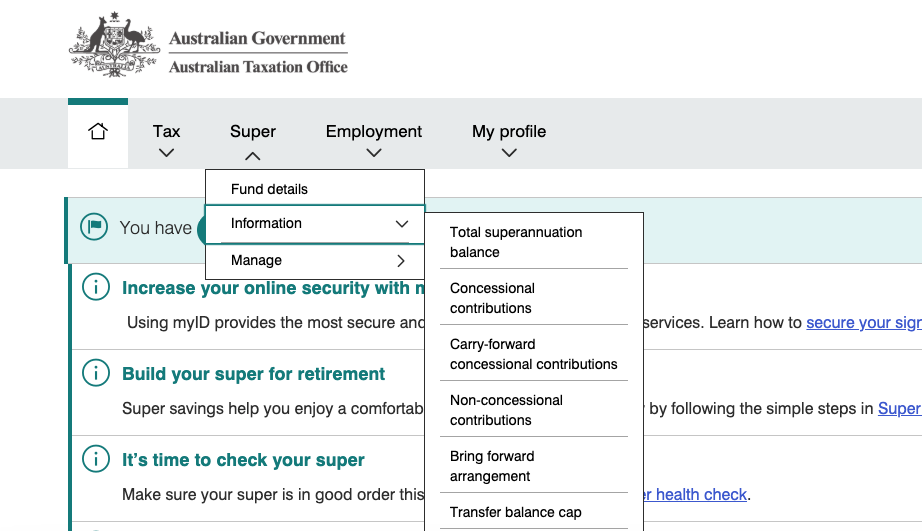
Now, as you have alluded to, your total super balance must be under $500,000 to use catch-up concessional contributions. Otherwise, you are stuck using just the annual cap.
For total super balance purposes, there is only one date that matters. That is the previous June 30 figure.
As long as your super balance is below $500,000 on June 30, then you can use the carry-forward rule in the following year. That’s true regardless of whether your balance was over $500,000 at any point prior to June 30 or after that date.
So yes, if your balance is looking like it will be just over $500,000 by June 30, you can make a withdrawal before the end of the financial year to keep it under that amount. This would allow you then to use the carry-forward rule in the following financial year.
Of course, this strategy is available only to individuals who can access some of their super. Generally, those aged 60 and over.
Question 3
At 75 years of age, and retired, are all avenues to contribute to super completely cut-off? If not what might those avenues be?
At age 75, you can no longer make voluntary contributions. However, an exception is the super downsiser contributions of up to $300,000 (each for a couple).
There are rules around this, including that you must have owned the home for at least 10 years and not previously used this contribution type.
The other contribution type that is still accepted post-75 is mandated employer contributions. Most commonly that is normal employer contributions.
Craig Sankey is a licensed financial adviser and head of Technical Services and Advice Enablement at Industry Fund Services.
Disclaimer: The responses provided are general in nature, and while they are prompted by the questions asked, they have been prepared without taking into consideration all your objectives, financial situation or needs.
Before relying on any of the information, please ensure that you consider the appropriateness of the information for your objectives, financial situation or needs. To the extent that it is permitted by law, no responsibility for errors or omissions is accepted by IFS and its representatives.
Want to see more stories from InDaily Qld in your Google search results?
- Click here to set InDaily Qld as a preferred source.
- Tick the box next to "InDaily Qld". That's it.