Drivers rescued as freak deluge exceeds predictions
A freak deluge defied predictions in south-east Queensland, dumping hundreds of millimetres of rain in a few hours.
Source: 10 News
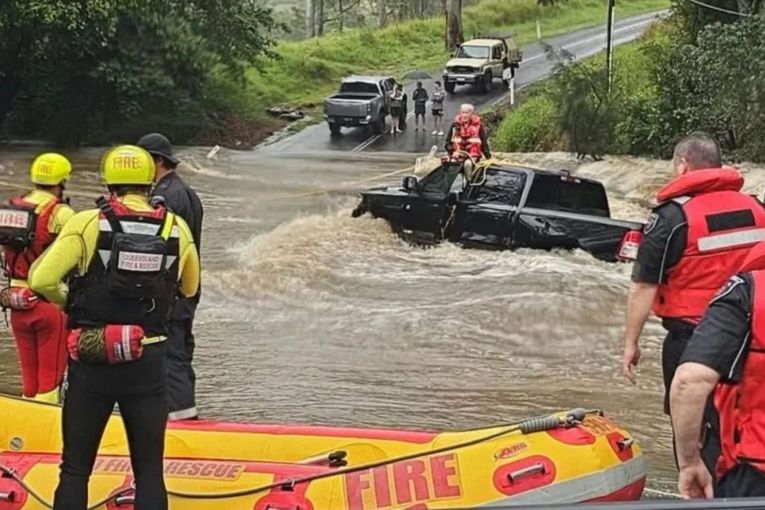
A driver was lucky not to be swept away with his RAM ute in raging floodwaters as a freak deluge defied predictions in south-east Queensland, dumping hundreds of millimetres.
Swiftwater rescuers worked for almost 20 minutes to save the man who was perched on his car’s roof as currents swirled around him at Rocksberg, west of Caboolture, on Thursday.
He became stranded as the Caboolture River rose dramatically, with 240 millimetres falling on the area in six hours.
‘“Stop, stay where you are. Hop on the roof, you’re doing really good,” one rescuer ordered.
Video shows that – moments before the vehicle washes away in the torrent – rescuers pull the man to safety with ropes.
Fire and Rescue Queensland’s Brendan Smith said the man narrowly avoided being swept away as the vehicle suddenly shifted.
“That man was extremely lucky there,” he told the Seven Network.
You might like
“You notice that vehicle was swept downstream, he would have gone with it.”
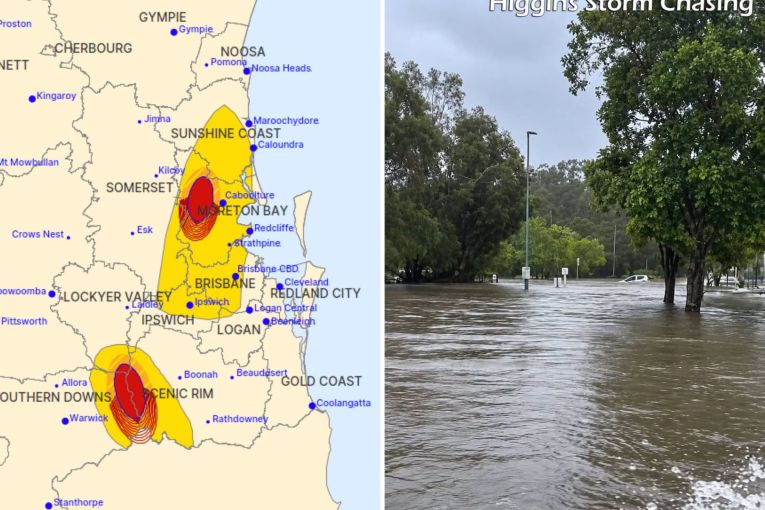
Multiple people were plucked to safety in swiftwater rescues as dangerous, slow-moving thunderstorms dumped record rainfall on south-east Queensland on Thursday.
Police said there were 15 swiftwater rescues and more than 500 callouts to the SES.
Twenty-four hour rainfall in some areas topped 300 millimetres, vastly exceeding the weather bureau’s predictions.
Some 100 millimetres had been expected at Caboolture, south of the Sunshine Coast, but it actually got 240 millimetres on Thursday morning. Moorina, north-west of Brisbane, had 206 millimetres.
That was “a tonne of rain to fall in a six-hour period anywhere in the country”, the Bureau of Meteorology’s Angus Hines said.
There was also 231 millimetres at Morayfield, north of Brisbane, where a driver was rescued from his sinking vehicle. An ABC reporter and a bystander swam to rescue the trapped man before his car completely submerged.
“Had those people not intervened … there’s every chance that fellow would have died,” Queensland Police state disaster co-ordinator Chris Stream said.
Stay informed, daily
“The car was three-quarters submerged, just the back end was tipping up, and luckily they were able to get to him and pull him out.”
The electrical systems on modern vehicles created additional risk, because water could prevent windows from opening and water pressure could prevent doors from opening, he said.
A truck driver drove into floodwaters at Goondiwindi and plucked a stranded driver from his vehicle, and another driver at Petrie had been rescued by community members.
QFES state co-ordinator Doug May said rescue crews had been called to nine incidents since 11pm on Wednesday, but the vehicle occupants had either self-extracted or been rescued by passersby.
Extra rescue crews remain on stand-by until Monday, when severe storms are again forecast, with the risk of hail.
The weather bureau said heavy rainfall from severe thunderstorms had caused flash flooding across the south-east. Caboolture residents were warned to prepare to leave as floodwaters rise rapidly.
Meteorologist Robert Urbaniak said the region was “definitely not out of the woods yet”.
Caboolture resident Sara Wessling said the flash flooding on Thursday morning was the worst she had seen.
“I had just walked over to have a look at how deep it was getting and saw an older guy flashing his headlights as he had driven into the water not realising how deep it was,” she said.
She called triple zero and emergency services arrived quickly.
“Another small four-wheel drive drove straight into it and ended up needing help as well — as far as I know all the people in both vehicles were fine,” Wessling said.
The weather system affected the Sunshine Coast and parts of Brisbane, from Maroochydore through to Ipswich. At least a dozen schools across the region were closed.
Urbaniak said the weather conditions were the perfect storm.
“Because the winds are quite slow coming off the ocean, and the winds through the first few kilometres of the atmosphere are quite slow, that means the storms are slow moving, so that’s what’s making it worse,” he said.
-with AAP
Want to see more stories from InDaily Qld in your Google search results?
- Click here to set InDaily Qld as a preferred source.
- Tick the box next to "InDaily Qld". That's it.